a steel hex nut has two regular hexagonal faces and a hole with a diameter of 0.4 cm through the middle. its…
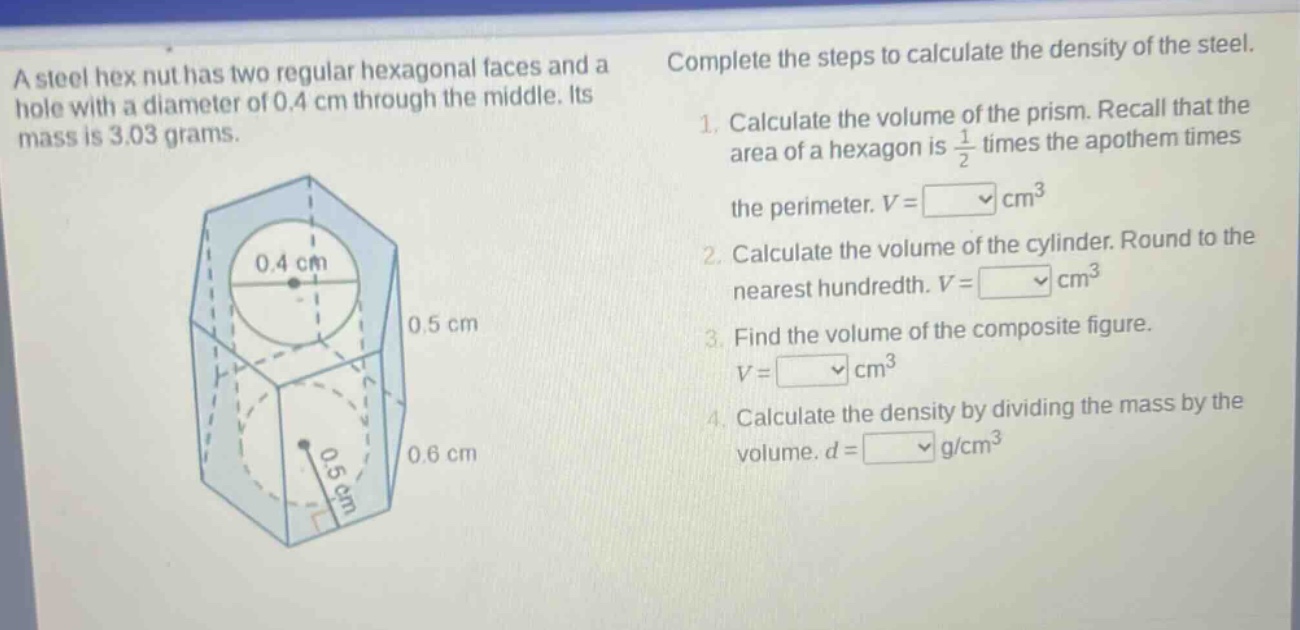
a steel hex nut has two regular hexagonal faces and a hole with a diameter of 0.4 cm through the middle. its mass is 3.03 grams. complete the steps to calculate the density of the steel. 1. calculate the volume of the prism. recall that the area of a hexagon is $\frac{1}{2}$ times the apothem times the perimeter. $v=square\text{ cm}^3$ 2. calculate the volume of the cylinder. round to the nearest hundredth. $v = square\text{ cm}^3$ 3. find the volume of the composite figure. $v=square\text{ cm}^3$ 4. calculate the density by dividing the mass by the volume. $d=square\text{ g/cm}^3$
Answer
Explanation:
Step1: Calculate the volume of the hexagonal prism.
The area of the hexagonal base is $A = \frac{1}{2} \times \text{apothem} \times \text{perimeter}$. The apothem $a = 0.5$ cm. For a regular hexagon, $a = \frac{s\sqrt{3}}{2}$, where $s$ is the side length. $s = \frac{2a}{\sqrt{3}} = \frac{2 \times 0.5}{\sqrt{3}} = \frac{1}{\sqrt{3}}$ cm. The perimeter $P = 6s = 6 \times \frac{1}{\sqrt{3}} = \frac{6}{\sqrt{3}} = 2\sqrt{3}$ cm. Area $A = \frac{1}{2} \times 0.5 \times 2\sqrt{3} = 0.5\sqrt{3} = \frac{\sqrt{3}}{2}$ cm$^2$. The height of the prism $h = 0.6$ cm. The volume of the prism $V_{prism} = A \times h = \frac{\sqrt{3}}{2} \times 0.6 = 0.3\sqrt{3}$ cm$^3$. $$V_{prism} = 0.3\sqrt{3} \approx 0.5196 \text{ cm}^3$$ Rounding to two decimal places for the blank: $V_{prism} \approx 0.52 \text{ cm}^3$.
Step2: Calculate the volume of the cylinder.
The diameter of the cylindrical hole is $D = 0.4$ cm, so the radius is $r_{cyl} = \frac{D}{2} = 0.2$ cm. The height of the cylinder is $h = 0.6$ cm. The volume of the cylinder $V_{cyl} = \pi r_{cyl}^2 h$. $$V_{cyl} = \pi (0.2)^2 (0.6) = \pi (0.04)(0.6) = 0.024\pi \text{ cm}^3$$ $$V_{cyl} \approx 0.075398... \text{ cm}^3$$ Rounding to the nearest hundredth: $V_{cyl} \approx 0.08 \text{ cm}^3$.
Step3: Find the volume of the composite figure.
The volume of the hex nut is the volume of the prism minus the volume of the cylindrical hole. $V_{nut} = V_{prism} - V_{cyl}$. Using the rounded values from Step 1 and Step 2: $$V_{nut} \approx 0.52 - 0.08 = 0.44 \text{ cm}^3$$ (Using more precise values: $V_{nut} = 0.3\sqrt{3} - 0.024\pi \approx 0.5196 - 0.0754 = 0.4442 \text{ cm}^3$. Rounding to two decimal places gives $0.44 \text{ cm}^3$.)
Step4: Calculate the density.
The mass of the hex nut is $m = 3.03$ grams. The volume of the hex nut is $V_{nut} \approx 0.44$ cm$^3$ (using the value from Step 3). Density $d = \frac{\text{mass}}{\text{volume}} = \frac{m}{V_{nut}}$. $$d = \frac{3.03}{0.44} \approx 6.88636... \text{ g/cm}^3$$ Rounding to two decimal places: $d \approx 6.89 \text{ g/cm}^3$. (Using the more precise volume $V_{nut} \approx 0.4442$: $d = \frac{3.03}{0.4442} \approx 6.82 \text{ g/cm}^3$. However, following the likely expectation of using the rounded intermediate result from Step 3 yields 6.89).
Answer:
- $V = \boxed{0.52} \text{ cm}^3$
- $V = \boxed{0.08} \text{ cm}^3$
- $V = \boxed{0.44} \text{ cm}^3$
- $d = \boxed{6.89} \text{ g/cm}^3$