a student is comparing two different types of circuits, both are shown in the diagram. which conclusion…
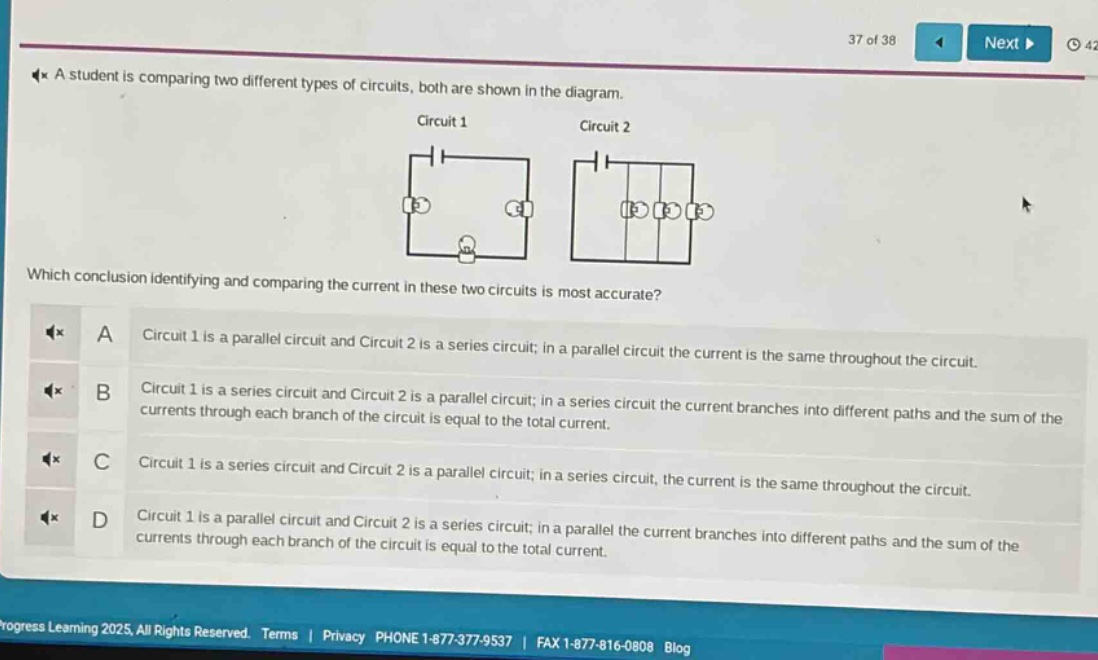
a student is comparing two different types of circuits, both are shown in the diagram. which conclusion identifying and comparing the current in these two circuits is most accurate? a circuit 1 is a parallel circuit and circuit 2 is a series circuit; in a parallel circuit the current is the same throughout the circuit. b circuit 1 is a series circuit and circuit 2 is a parallel circuit; in a series circuit the current branches into different paths and the sum of the currents through each branch of the circuit is equal to the total current. c circuit 1 is a series circuit and circuit 2 is a parallel circuit; in a series circuit, the current is the same throughout the circuit. d circuit 1 is a parallel circuit and circuit 2 is a series circuit; in a parallel the current branches into different paths and the sum of the currents through each branch of the circuit is equal to the total current.
Answer
Brief Explanations:
-
Series Circuit: In a series circuit, components are connected end - to - end, so there is only one path for current to flow. By Kirchhoff's current law, the current is the same throughout a series circuit. Circuit 1 is a series circuit as the bulbs are connected in a single - path loop.
-
Parallel Circuit: In a parallel circuit, components are connected across common points (or junctions), creating multiple paths for current. The total current in a parallel circuit is the sum of the currents through each branch (by Kirchhoff's current law: (I_{total}=I_1 + I_2+\cdots+I_n)). Circuit 2 is a parallel circuit as the bulbs are connected across two common points, providing multiple current paths.
-
Analysis of Options:
- Option A: Circuit 1 is not a parallel circuit (it's a series circuit), and in a parallel circuit, the current is not the same throughout (it splits into branches). So, Option A is incorrect.
- Option B: In a series circuit, the current does not branch (there is only one path). So, Option B is incorrect.
- Option C: Circuit 1 is a series circuit (correct), Circuit 2 is a parallel circuit (correct), and in a series circuit, the current is the same throughout (correct by the property of series circuits).
- Option D: Circuit 1 is not a parallel circuit (it's a series circuit). So, Option D is incorrect.
Answer:
C. Circuit 1 is a series circuit and Circuit 2 is a parallel circuit; in a series circuit, the current is the same throughout the circuit.