a student who did the same experiment that you did determined the specific heat for all of the metals. his…
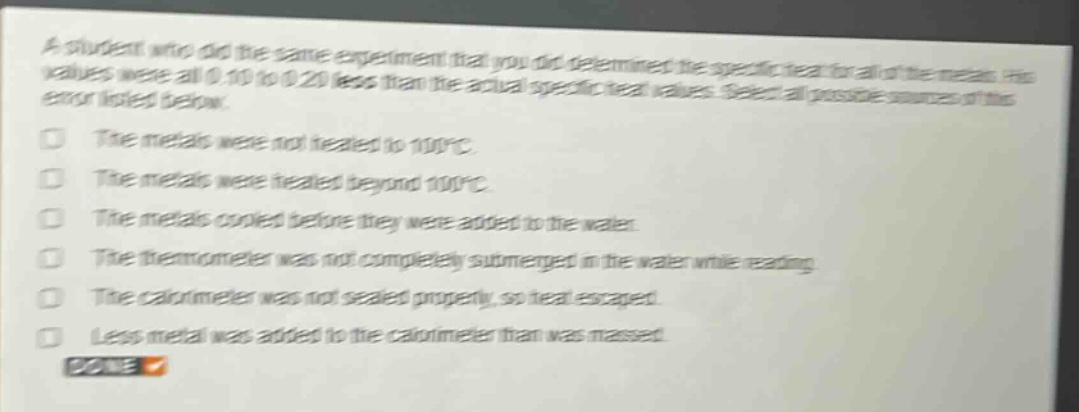
a student who did the same experiment that you did determined the specific heat for all of the metals. his values were all 0.10 to 0.20 less than the actual specific heat values. select all possible sources of this error listed below.\nthe metals were not heated to 100°c.\nthe metals were heated beyond 100°c.\nthe metals cooled before they were added to the water.\nthe thermometer was not completely submerged in the water while reading.\nthe calorimeter was not sealed properly, so heat escaped.\nless metal was added to the calorimeter than was massed.\ndone
Answer
Brief Explanations:
- If metals are not heated to 100°C, less heat is available for transfer, leading to lower - measured specific heat values.
- Heating metals beyond 100°C doesn't directly cause lower - measured specific heat values as long as heat transfer is accounted for correctly.
- If metals cool before being added to water, less heat is transferred to the water, resulting in lower - measured specific heat values.
- If the thermometer is not completely submerged, it may give an inaccurate temperature reading, but this doesn't necessarily cause consistently lower specific heat values.
- If the calorimeter is not sealed properly and heat escapes, less heat is available for the water - metal system, leading to lower - measured specific heat values.
- If less metal is added to the calorimeter than was massed, the calculated specific heat will be lower as the heat transfer is based on the incorrect (higher) mass value.
Answer:
The metals were not heated to 100°C, The metals cooled before they were added to the water, The calorimeter was not sealed properly, so heat escaped, Less metal was added to the calorimeter than was massed