a student places a large pot of cold water on a stove and heats it for one minute. then she takes the pot of…
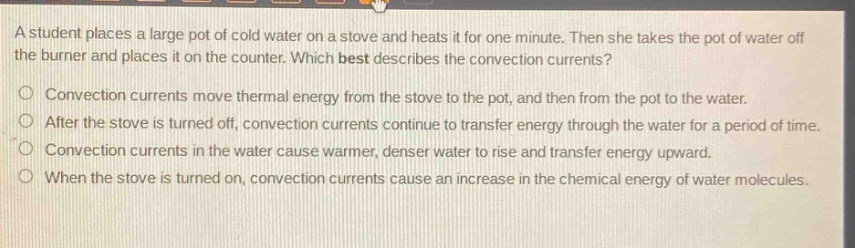
a student places a large pot of cold water on a stove and heats it for one minute. then she takes the pot of water off the burner and places it on the counter. which best describes the convection currents?\nconvection currents move thermal energy from the stove to the pot, and then from the pot to the water.\nafter the stove is turned off, convection currents continue to transfer energy through the water for a period of time.\nconvection currents in the water cause warmer, denser water to rise and transfer energy upward.\nwhen the stove is turned on, convection currents cause an increase in the chemical energy of water molecules.
Answer
Brief Explanations:
Convection is the transfer of heat by the movement of a fluid. When the water is heated, convection currents are set - up. Even after the heat source (stove) is removed, the warmer water is still less dense and continues to move, transferring energy through the water for a while due to the inertia of the fluid motion and the temperature gradient that still exists initially. Warmer water is less dense and rises. Convection is related to thermal energy transfer, not chemical energy change. Also, the transfer from stove to pot is mainly conduction at first contact surface, and then from pot to water is a combination of conduction and convection.
Answer:
After the stove is turned off, convection currents continue to transfer energy through the water for a period of time.