students are completing a lab in which they let a lab cart roll down a ramp. the students record the mass of…
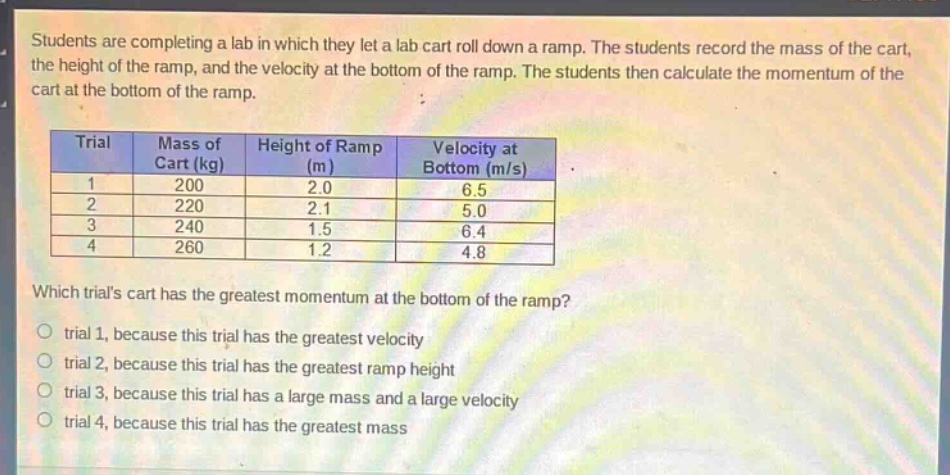
students are completing a lab in which they let a lab cart roll down a ramp. the students record the mass of the cart, the height of the ramp, and the velocity at the bottom of the ramp. the students then calculate the momentum of the cart at the bottom of the ramp.\n\n| trial | mass of cart (kg) | height of ramp (m) | velocity at bottom (m/s) |\n| ---- | ---- | ---- | ---- |\n| 1 | 200 | 2.0 | 6.5 |\n| 2 | 220 | 2.1 | 5.0 |\n| 3 | 240 | 1.5 | 6.4 |\n| 4 | 260 | 1.2 | 4.8 |\n\nwhich trials cart has the greatest momentum at the bottom of the ramp?\no trial 1, because this trial has the greatest velocity\no trial 2, because this trial has the greatest ramp height\no trial 3, because this trial has a large mass and a large velocity\no trial 4, because this trial has the greatest mass
Answer
Explanation:
Step1: Recall momentum formula
The formula for momentum is $p = mv$, where $p$ is momentum, $m$ is mass and $v$ is velocity.
Step2: Calculate momentum for trial 1
For trial 1, $m_1=200$ kg and $v_1 = 6.5$ m/s. So $p_1=m_1v_1=200\times6.5 = 1300$ kg·m/s.
Step3: Calculate momentum for trial 2
For trial 2, $m_2 = 220$ kg and $v_2=5.0$ m/s. So $p_2=m_2v_2=220\times5.0=1100$ kg·m/s.
Step4: Calculate momentum for trial 3
For trial 3, $m_3 = 240$ kg and $v_3 = 6.4$ m/s. So $p_3=m_3v_3=240\times6.4 = 1536$ kg·m/s.
Step5: Calculate momentum for trial 4
For trial 4, $m_4=260$ kg and $v_4 = 4.8$ m/s. So $p_4=m_4v_4=260\times4.8=1248$ kg·m/s.
Step6: Compare momentums
Comparing $p_1 = 1300$ kg·m/s, $p_2=1100$ kg·m/s, $p_3 = 1536$ kg·m/s and $p_4=1248$ kg·m/s, we can see that $p_3$ is the largest.
Answer:
trial 3, because this trial has a large mass and a large velocity