students perform an experiment in which they drop two eggs with equal mass from a balcony. in the first…
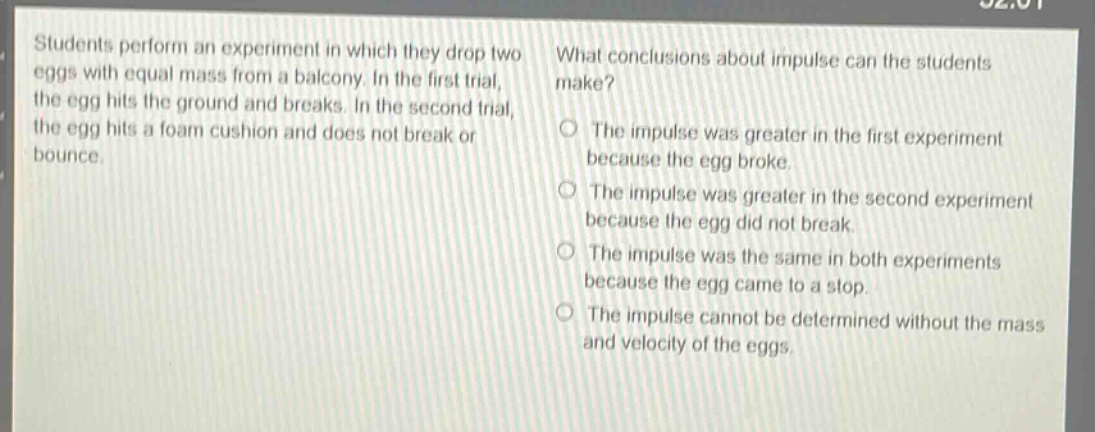
students perform an experiment in which they drop two eggs with equal mass from a balcony. in the first trial, the egg hits the ground and breaks. in the second trial, the egg hits a foam cushion and does not break or bounce. what conclusions about impulse can the students make? the impulse was greater in the first experiment because the egg broke. the impulse was greater in the second experiment because the egg did not break. the impulse was the same in both experiments because the egg came to a stop. the impulse cannot be determined without the mass and velocity of the eggs.
Answer
Explanation:
Step1: Recall impulse - momentum theorem
Impulse $J=\Delta p = m\Delta v$. The eggs have equal mass and are dropped from the same height, so they have the same initial velocity just before hitting the surface. In both cases, the final velocity is zero (the egg either breaks and stops or lands on the foam and stops).
Step2: Calculate change in momentum
Since $\Delta p = m(v_f - v_i)$ and $v_f = 0$ and $v_i$ is the same for both eggs (due to same - height drop), the change in momentum $\Delta p$ is the same for both eggs. According to the impulse - momentum theorem, impulse $J=\Delta p$. So the impulse is the same in both experiments.
Answer:
The impulse was the same in both experiments because the egg came to a stop.