students study how quickly blocks of two different metals, iron and aluminum, transfer thermal energy to…
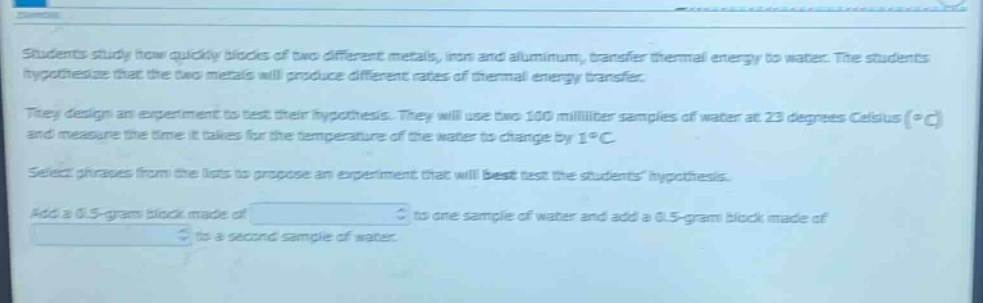
students study how quickly blocks of two different metals, iron and aluminum, transfer thermal energy to water. the students hypothesize that the two metals will produce different rates of thermal energy transfer. they design an experiment to test their hypothesis. they will use two 100 - milliliter samples of water at 23 degrees celsius (°c) and measure the time it takes for the temperature of the water to change by 1°c. select phrases from the lists to propose an experiment that will best test the students hypothesis. add a 0.5 - gram block made of to one sample of water and add a 0.5 - gram block made of to a second sample of water.
Answer
Brief Explanations:
To test the hypothesis about different rates of thermal - energy transfer between iron and aluminum, the experiment should directly compare the two metals. So, one sample of water should have an iron block and the other should have an aluminum block.
Answer:
Add a 0.5 - gram block made of iron to one sample of water and add a 0.5 - gram block made of aluminum to a second sample of water.