substance x has a fixed volume, and the attraction between its particles is strong. substance y has widely…
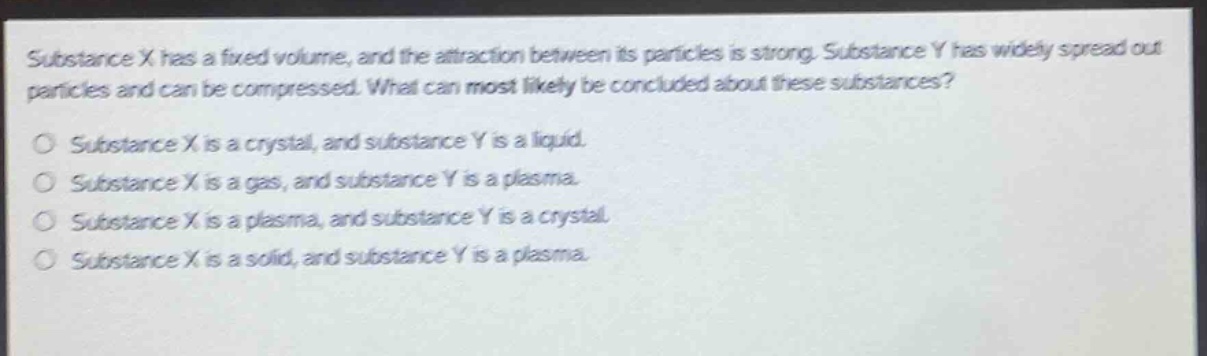
substance x has a fixed volume, and the attraction between its particles is strong. substance y has widely spread out particles and can be compressed. what can most likely be concluded about these substances? substance x is a crystal, and substance y is a liquid. substance x is a gas, and substance y is a plasma. substance x is a plasma, and substance y is a crystal. substance x is a solid, and substance y is a plasma.
Answer
Brief Explanations:
Solids have a fixed volume and strong particle - particle attractions. Gases and plasmas have widely spread - out particles and can be compressed. Crystals are a type of solid. Liquids have a fixed volume but weaker particle attractions compared to solids and are not easily compressed like the description of Y.
Answer:
None of the given options are correct. Substance X is a solid (crystals are a type of solid), and substance Y is a gas or plasma. If we assume from the given options, the closest correct - like option would be that substance X is a solid (crystal is a solid form) and substance Y is a gas (since plasma is less common in everyday examples and gas has the described properties of widely spread out particles and compressibility), but the option with gas is not present. If we have to choose from the given ones, there is no correct answer as plasma is not the typical match for Y based on the simple description and the options don't have a gas option.