suppose the initial position of an object is zero, the starting velocity is 3 m/s and the final velocity was…
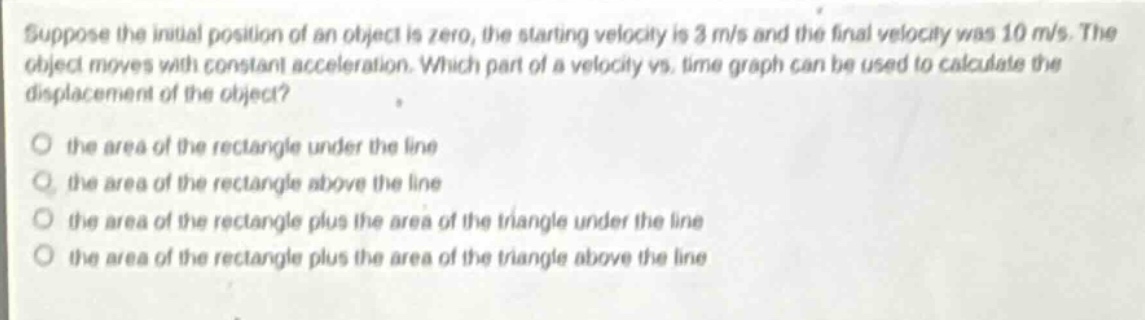
suppose the initial position of an object is zero, the starting velocity is 3 m/s and the final velocity was 10 m/s. the object moves with constant acceleration. which part of a velocity - vs. time graph can be used to calculate the displacement of the object?\no the area of the rectangle under the line\no the area of the rectangle above the line\no the area of the rectangle plus the area of the triangle under the line\no the area of the rectangle plus the area of the triangle above the line
Answer
Brief Explanations:
The displacement of an object on a velocity - time graph is given by the area under the curve. For an object with an initial non - zero velocity and constant acceleration, the velocity - time graph is a straight line with a positive slope. The area under this line consists of a rectangle (representing the displacement due to the initial velocity) and a triangle (representing the additional displacement due to the acceleration).
Answer:
the area of the rectangle plus the area of the triangle under the line