suppose an objects initial velocity is 10 m/s and its final velocity is 4 m/s. mass is constant. what can…
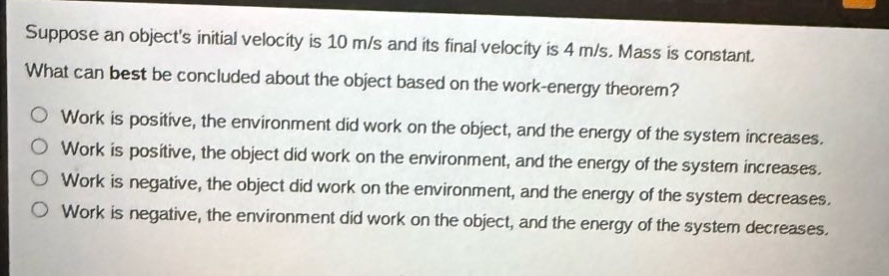
suppose an objects initial velocity is 10 m/s and its final velocity is 4 m/s. mass is constant. what can best be concluded about the object based on the work - energy theorem? work is positive, the environment did work on the object, and the energy of the system increases. work is positive, the object did work on the environment, and the energy of the system increases. work is negative, the object did work on the environment, and the energy of the system decreases. work is negative, the environment did work on the object, and the energy of the system decreases.
Answer
Explanation:
Step1: Recall work - energy theorem
The work - energy theorem is $W=\Delta K = K_f - K_i$, where $W$ is the net work done on the object, $K_f$ is the final kinetic energy and $K_i$ is the initial kinetic energy. The kinetic energy formula is $K=\frac{1}{2}mv^2$.
Step2: Analyze initial and final kinetic energies
Given $v_i = 10\ m/s$ and $v_f=4\ m/s$, and mass $m$ is constant. Since $K=\frac{1}{2}mv^2$, and $v_f<v_i$, then $K_f=\frac{1}{2}mv_f^2<\frac{1}{2}mv_i^2 = K_i$. So $\Delta K=K_f - K_i<0$.
Step3: Determine the sign of work
From $W = \Delta K$, since $\Delta K<0$, then $W<0$. When work is negative, the object does work on the environment, and the energy of the system (kinetic energy in this case) decreases.
Answer:
Work is negative, the object did work on the environment, and the energy of the system decreases.