the table represents the forces on four objects, with directions. which best explains the forces acting on…
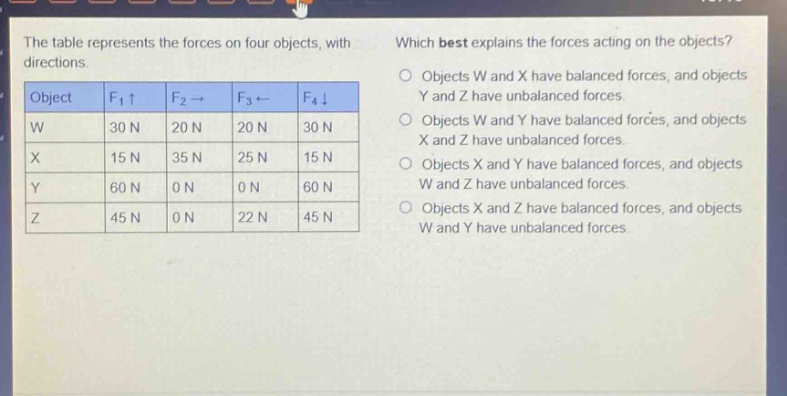
the table represents the forces on four objects, with directions. which best explains the forces acting on the objects? object f1↑ f2→ f3← f4↓ w 30 n 20 n 20 n 30 n x 15 n 35 n 25 n 15 n y 60 n 0 n 0 n 60 n z 45 n 0 n 22 n 45 n objects w and x have balanced forces, and objects y and z have unbalanced forces. objects w and y have balanced forces, and objects x and z have unbalanced forces. objects x and y have balanced forces, and objects w and z have unbalanced forces. objects x and z have balanced forces, and objects w and y have unbalanced forces.
Answer
Explanation:
Step1: Calculate net - force for object W
For vertical forces: $F_{1}-F_{4}=30 - 30=0$ N. For horizontal forces: $F_{2}-F_{3}=20 - 20 = 0$ N. Net - force on W is 0 N, so W has balanced forces.
Step2: Calculate net - force for object X
For vertical forces: $F_{1}-F_{4}=15 - 15 = 0$ N. For horizontal forces: $F_{2}-F_{3}=35 - 25=10$ N. Net - force on X is not 0 N, so X has unbalanced forces.
Step3: Calculate net - force for object Y
For vertical forces: $F_{1}-F_{4}=60 - 60 = 0$ N. For horizontal forces: $F_{2}-F_{3}=0 - 0 = 0$ N. Net - force on Y is 0 N, so Y has balanced forces.
Step4: Calculate net - force for object Z
For vertical forces: $F_{1}-F_{4}=45 - 45 = 0$ N. For horizontal forces: $F_{2}-F_{3}=0 - 22=-22$ N. Net - force on Z is not 0 N, so Z has unbalanced forces.
Answer:
Objects W and Y have balanced forces, and objects X and Z have unbalanced forces.