the table shows information about four students who are running around a track. motion of students student…
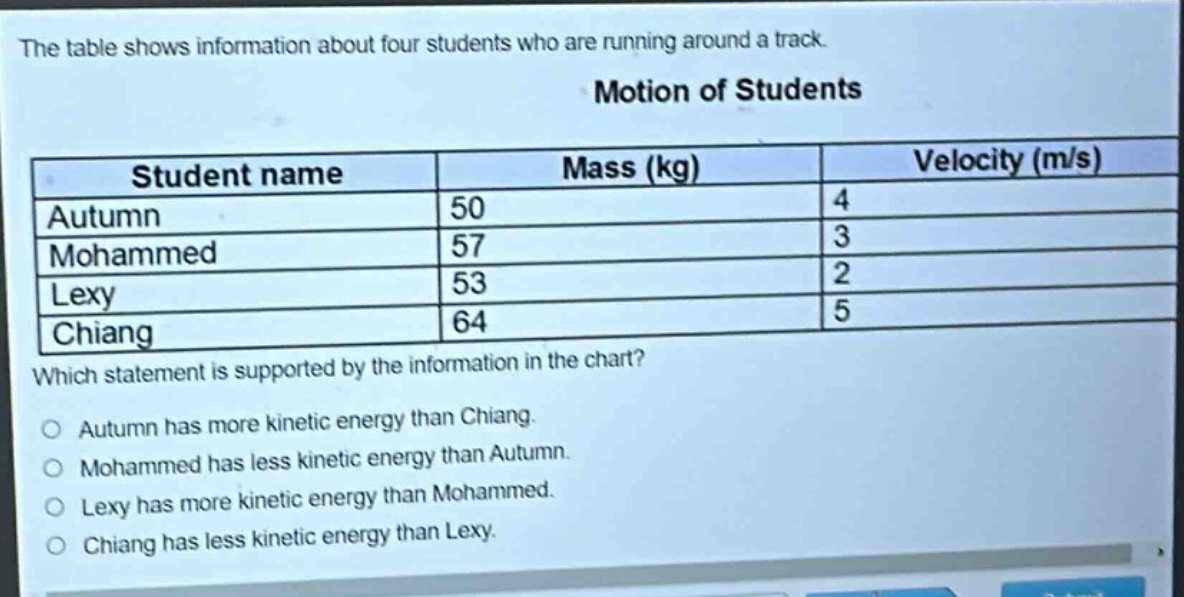
the table shows information about four students who are running around a track. motion of students student name mass (kg) velocity (m/s) autumn 50 4 mohammed 57 3 lexy 53 2 chiang 64 5 which statement is supported by the information in the chart? autumn has more kinetic energy than chiang. mohammed has less kinetic energy than autumn. lexy has more kinetic energy than mohammed. chiang has less kinetic energy than lexy.
Answer
Explanation:
Step1: Recall kinetic - energy formula
The formula for kinetic energy is $KE=\frac{1}{2}mv^{2}$, where $m$ is mass and $v$ is velocity.
Step2: Calculate Autumn's kinetic energy
For Autumn, $m = 50$ kg and $v = 4$ m/s. So, $KE_{Autumn}=\frac{1}{2}\times50\times4^{2}=\frac{1}{2}\times50\times16 = 400$ J.
Step3: Calculate Mohammed's kinetic energy
For Mohammed, $m = 57$ kg and $v = 3$ m/s. So, $KE_{Mohammed}=\frac{1}{2}\times57\times3^{2}=\frac{1}{2}\times57\times9=256.5$ J.
Step4: Calculate Lexy's kinetic energy
For Lexy, $m = 53$ kg and $v = 2$ m/s. So, $KE_{Lexy}=\frac{1}{2}\times53\times2^{2}=\frac{1}{2}\times53\times4 = 106$ J.
Step5: Calculate Chiang's kinetic energy
For Chiang, $m = 64$ kg and $v = 5$ m/s. So, $KE_{Chiang}=\frac{1}{2}\times64\times5^{2}=\frac{1}{2}\times64\times25 = 800$ J.
Step6: Compare kinetic - energy values
$KE_{Autumn}=400$ J, $KE_{Mohammed}=256.5$ J, $KE_{Lexy}=106$ J, $KE_{Chiang}=800$ J. Since $256.5<400$, Mohammed has less kinetic energy than Autumn.