the table shows the mechanical energy and velocity of a rock that was thrown four times. the rock has a mass…
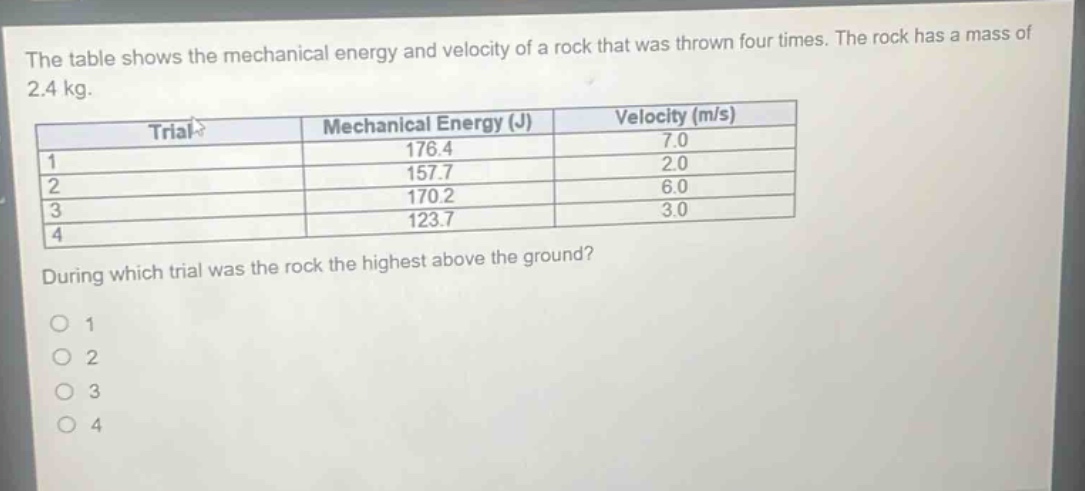
the table shows the mechanical energy and velocity of a rock that was thrown four times. the rock has a mass of 2.4 kg.\n|trial|mechanical energy (j)|velocity (m/s)|\n|----|----|----|\n|1|176.4|7.0|\n|2|157.7|2.0|\n|3|170.2|6.0|\n|4|123.7|3.0|\nduring which trial was the rock the highest above the ground?\no 1\no 2\no 3\no 4
Answer
Explanation:
Step1: Recall mechanical - energy formula
Mechanical energy $E = K+U$, where kinetic energy $K=\frac{1}{2}mv^{2}$ and potential energy $U = mgh$. We can find $K$ for each trial and then $U$.
Step2: Calculate kinetic energy for trial 1
Given $m = 2.4$ kg and $v_1=7.0$ m/s, $K_1=\frac{1}{2}\times2.4\times7.0^{2}=\frac{1}{2}\times2.4\times49 = 58.8$ J. Then $U_1=E_1 - K_1=176.4 - 58.8 = 117.6$ J.
Step3: Calculate kinetic energy for trial 2
Given $m = 2.4$ kg and $v_2 = 2.0$ m/s, $K_2=\frac{1}{2}\times2.4\times2.0^{2}=\frac{1}{2}\times2.4\times4 = 4.8$ J. Then $U_2=E_2 - K_2=157.7 - 4.8 = 152.9$ J.
Step4: Calculate kinetic energy for trial 3
Given $m = 2.4$ kg and $v_3 = 6.0$ m/s, $K_3=\frac{1}{2}\times2.4\times6.0^{2}=\frac{1}{2}\times2.4\times36 = 43.2$ J. Then $U_3=E_3 - K_3=170.2 - 43.2 = 127$ J.
Step5: Calculate kinetic energy for trial 4
Given $m = 2.4$ kg and $v_4 = 3.0$ m/s, $K_4=\frac{1}{2}\times2.4\times3.0^{2}=\frac{1}{2}\times2.4\times9 = 10.8$ J. Then $U_4=E_4 - K_4=123.7 - 10.8 = 112.9$ J.
Step6: Compare potential energies
Since $U = mgh$ and $m$ and $g$ are constant, higher $U$ means higher $h$. We have $U_2(152.9\text{ J})>U_3(127\text{ J})>U_1(117.6\text{ J})>U_4(112.9\text{ J})$.
Answer:
2