the table below shows the speed of sound waves from musical sound sources at 20°c.\nwavelengths (m)…
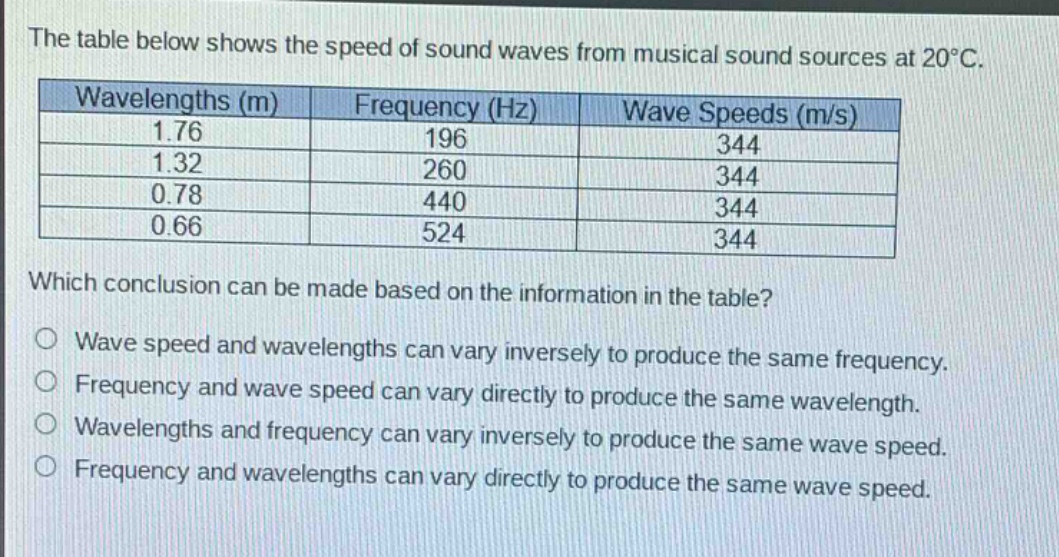
the table below shows the speed of sound waves from musical sound sources at 20°c.\nwavelengths (m) frequency (hz) wave speeds (m/s)\n1.76 196 344\n1.32 260 344\n0.78 440 344\n0.66 524 344\nwhich conclusion can be made based on the information in the table?\nwave speed and wavelengths can vary inversely to produce the same frequency.\nfrequency and wave speed can vary directly to produce the same wavelength.\nwavelengths and frequency can vary inversely to produce the same wave speed.\nfrequency and wavelengths can vary directly to produce the same wave speed.
Answer
Answer:
Wavelengths and frequency can vary inversely to produce the same wave speed.
Explanation:
Step1: Recall wave - speed formula
The wave - speed formula is $v = f\lambda$, where $v$ is wave speed, $f$ is frequency, and $\lambda$ is wavelength.
Step2: Analyze table data
In the table, wave speed $v = 344$ m/s is constant. As wavelength $\lambda$ decreases (e.g., from 1.76 m to 0.66 m), frequency $f$ increases (from 196 Hz to 524 Hz).
Step3: Determine relationship
Since $v$ is constant and $v = f\lambda$, when one variable ($\lambda$) decreases and the other ($f$) increases, they vary inversely to keep $v$ the same.