task 3: go to the home button to reset. search for the iss - zarya and go to its orbit. 1. describe the iss…
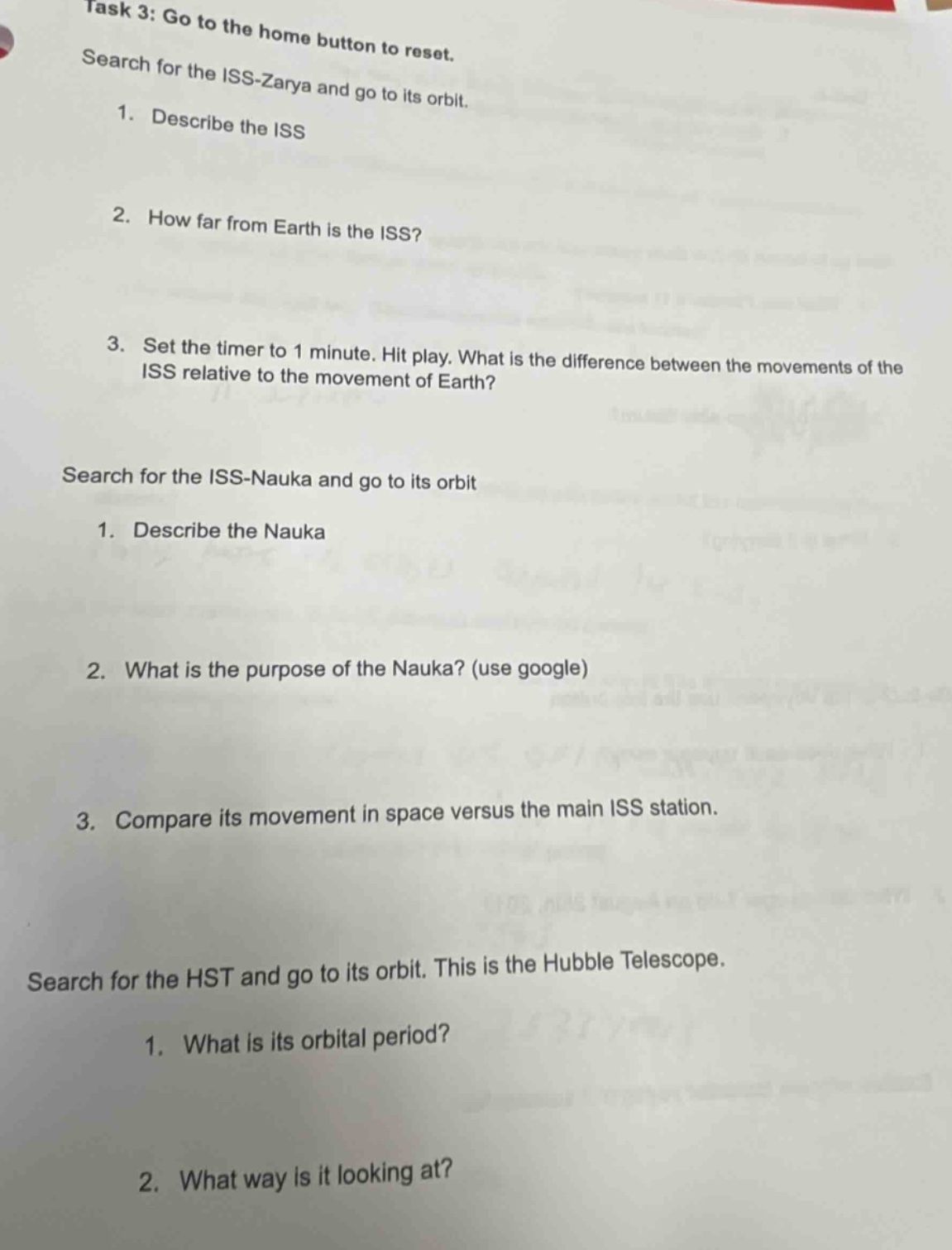
task 3: go to the home button to reset. search for the iss - zarya and go to its orbit. 1. describe the iss 2. how far from earth is the iss? 3. set the timer to 1 minute. hit play. what is the difference between the movements of the iss relative to the movement of earth? search for the iss - nauka and go to its orbit 1. describe the nauka 2. what is the purpose of the nauka? (use google) 3. compare its movement in space versus the main iss station. search for the hst and go to its orbit. this is the hubble telescope. 1. what is its orbital period? 2. what way is it looking at?
Answer
Explanation:
Step1: Describe the ISS
The International Space Station (ISS) is a modular space station in low - Earth orbit. It is a habitable artificial satellite. It serves as a microgravity and space environment research laboratory where scientific research in biology, physics, astronomy, and meteorology is conducted.
Step2: Distance of ISS from Earth
The ISS orbits at an average altitude of about 408 kilometers (254 miles) above Earth's surface.
Step3: Movement difference between ISS and Earth
The ISS moves at a speed of about 27,600 kilometers per hour (17,100 mph) relative to Earth's surface. Earth rotates at a speed of about 1,670 kilometers per hour (1,040 mph) at the equator. In one minute, the ISS travels a distance (d_{ISS}=27600\times\frac{1}{60}=460) kilometers, while a point on the equator of Earth travels (d_{Earth}=1670\times\frac{1}{60}\approx27.83) kilometers. The difference in the distance traveled in one minute is (460 - 27.83 = 432.17) kilometers.
Step4: Describe the Nauka
Nauka is a multipurpose laboratory module of the ISS. It is the largest single - element module added to the ISS. It provides additional living and working space for astronauts, as well as new scientific research capabilities.
Step5: Purpose of Nauka
The main purposes of Nauka include expanding the living quarters for the ISS crew, providing new scientific research facilities for experiments in areas such as life sciences, material sciences, and Earth observation, and also enhancing the station's power, communication, and life - support systems.
Step6: Movement comparison of Nauka and main ISS
Nauka is attached to the ISS, so its overall movement in space is the same as the main ISS station as they are part of the same structure. However, Nauka may have some minor relative movements due to its own orientation and attitude - control systems for specific tasks such as pointing scientific instruments.
Step7: Orbital period of HST
The Hubble Space Telescope (HST) has an orbital period of about 95 minutes. It orbits Earth at an altitude of about 570 kilometers (350 miles).
Step8: Direction of HST
The Hubble Space Telescope can be pointed in different directions depending on the astronomical objects it is observing. It can observe deep - space objects such as galaxies, stars, nebulae, and also perform observations of the solar system objects. It has a wide - field and planetary camera, a space telescope imaging spectrograph, etc., which can be aimed at different targets in the universe.
Answer:
- The ISS is a modular space station in low - Earth orbit, a research laboratory for multiple sciences.
- About 408 kilometers (254 miles) above Earth's surface.
- The ISS moves much faster than Earth's rotation speed. In one minute, the difference in distance traveled is about 432.17 kilometers.
- Nauka is a large multipurpose laboratory module of the ISS, providing more living and working space and research capabilities.
- To expand crew living quarters, offer research facilities, and enhance station systems.
- Overall movement is the same as the main ISS, with possible minor relative movements for specific tasks.
- About 95 minutes.
- Can be pointed at various astronomical objects in the universe.