thompson, rutherford, bohr, planck, and einstein all contributed models to help describe the atom and atomic…
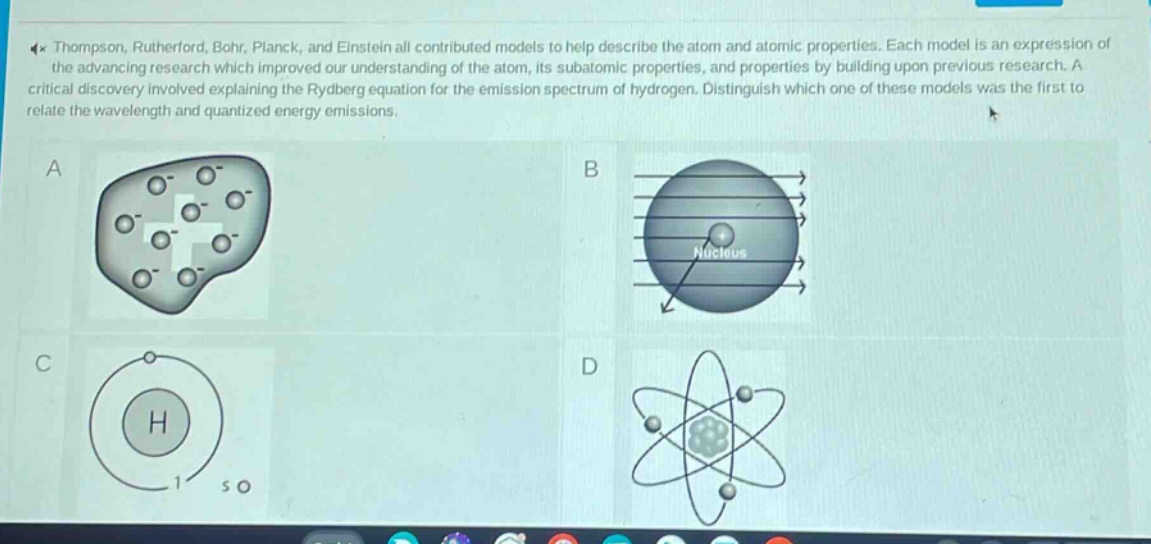
thompson, rutherford, bohr, planck, and einstein all contributed models to help describe the atom and atomic properties. each model is an expression of the advancing research which improved our understanding of the atom, its subatomic properties, and properties by building upon previous research. a critical discovery involved explaining the rydberg equation for the emission spectrum of hydrogen. distinguish which one of these models was the first to relate the wavelength and quantized energy emissions.
Answer
Brief Explanations:
- Option A: Thompson's "plum - pudding" model focused on the distribution of electrons within a positively charged "soup" but did not relate wavelength and quantized energy emissions.
- Option B: Rutherford's model described the atom as having a small, dense nucleus with electrons orbiting around it in a more general sense and did not specifically deal with the quantization of energy and wavelength for emissions.
- Option C: Bohr's model was the first to introduce the concept of quantized energy levels for electrons in an atom. It related the wavelength of light emitted (or absorbed) when an electron transitions between these quantized energy levels. The Rydberg equation for the emission spectrum of hydrogen can be explained using Bohr's model of quantized energy levels.
- Option D: This is a more complex model (similar to the quantum - mechanical model in some ways) which is more advanced than Bohr's model and not the first to relate wavelength and quantized energy emissions.
Answer:
C