what did j. j. thomson observe when he applied electric voltage to a cathode - ray tube in his famous…
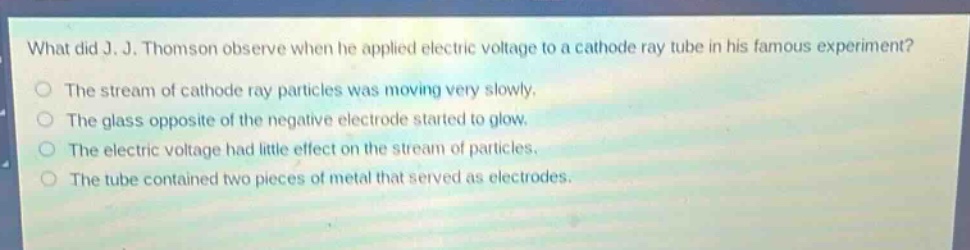
what did j. j. thomson observe when he applied electric voltage to a cathode - ray tube in his famous experiment?\nthe stream of cathode - ray particles was moving very slowly.\nthe glass opposite of the negative electrode started to glow.\nthe electric voltage had little effect on the stream of particles.\nthe tube contained two pieces of metal that served as electrodes.
Answer
Brief Explanations:
In J.J. Thomson's cathode - ray tube experiment, when an electric voltage was applied, the glass opposite the negative electrode (anode) started to glow due to the cathode - ray particles hitting it. The other options are either incorrect observations related to the effect of voltage or just descriptions of the tube setup rather than the key observation about the voltage's effect.
Answer:
The glass opposite of the negative electrode started to glow.