top 10 coolest moon facts name directions: read top 10 coolest moon facts and answer the questions below. 1…
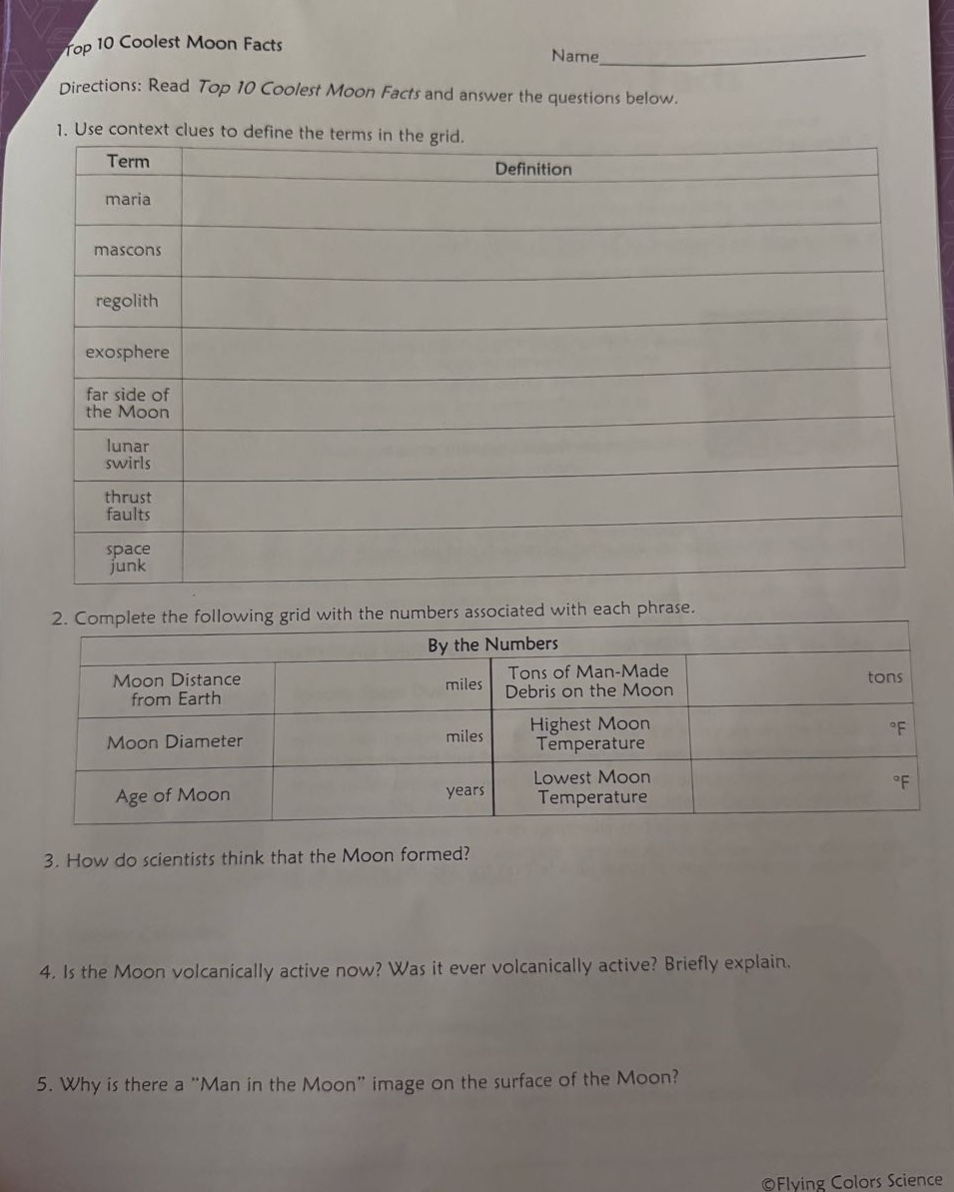
top 10 coolest moon facts name directions: read top 10 coolest moon facts and answer the questions below. 1. use context clues to define the terms in the grid. term definition maria mascons regolith exosphere far side of the moon lunar swirls thrust faults space junk 2. complete the following grid with the numbers associated with each phrase. by the numbers moon distance from earth miles tons of man - made debris on the moon tons moon diameter miles highest moon temperature °f age of moon years lowest moon temperature °f 3. how do scientists think that the moon formed? 4. is the moon volcanically active now? was it ever volcanically active? briefly explain. 5. why is there a “man in the moon” image on the surface of the moon? ©flying colors science
Answer
Brief Explanations:
- maria: Dark, flat regions on the Moon formed by ancient volcanic eruptions.
- Context: These are large - scale features visible on the Moon's surface.
- mascons: Mass concentrations on the Moon, detected by gravitational anomalies.
- Context: They affect the orbits of spacecraft around the Moon.
- regolith: Loose, fragmented material covering the Moon's surface.
- Context: Formed by meteorite impacts and other space - weathering processes.
- exosphere: The outermost layer of the Moon's atmosphere, extremely thin.
- Context: It has very few gas molecules and extends into space.
- far side of the Moon: The side of the Moon that is not visible from Earth due to synchronous rotation.
- Context: It has a different appearance and geology compared to the near side.
- lunar swirls: Bright, winding patterns on the Moon's surface, possibly related to magnetic fields.
- Context: Their exact origin is still being studied.
- thrust faults: Geological faults where one block of rock is pushed up over another, found on the Moon.
- Context: Indicate tectonic activity in the Moon's past.
- space junk: Man - made objects left in space, including on the Moon from past missions.
- Context: Includes discarded equipment and other debris.
- Without the text "Top 10 Coolest Moon Facts" for reference, we cannot fill in the numerical values. But generally:
- Moon Distance from Earth: Approximately 238,855 miles on average.
- Tons of Man - Made Debris on the Moon: Estimates vary, but it's a relatively small amount.
- Moon Diameter: About 2,159 miles.
- Highest Moon Temperature: Around 253°F in sunlight.
- Age of Moon: Approximately 4.51 billion years.
- Lowest Moon Temperature: Around - 387°F in shadow.
- The leading theory is the giant - impact hypothesis. A Mars - sized body named Theia collided with Earth early in the solar system's history. Debris from the impact accreted to form the Moon.
- The Moon is not volcanically active now. It was volcanically active in the past, mainly during the first few billion years of its existence. Lunar maria are evidence of past volcanic eruptions that filled large basins with lava.
- The "Man in the Moon" is an example of pareidolia, a psychological phenomenon where people see recognizable shapes or patterns in random or ambiguous stimuli. The dark maria and light highlands on the Moon's near - side create a pattern that some people interpret as a face.
Answer:
-
- maria: Dark, flat regions on the Moon formed by ancient volcanic eruptions.
- mascons: Mass concentrations on the Moon, detected by gravitational anomalies.
- regolith: Loose, fragmented material covering the Moon's surface.
- exosphere: The outermost layer of the Moon's atmosphere, extremely thin.
- far side of the Moon: The side of the Moon that is not visible from Earth due to synchronous rotation.
- lunar swirls: Bright, winding patterns on the Moon's surface, possibly related to magnetic fields.
- thrust faults: Geological faults where one block of rock is pushed up over another, found on the Moon.
- space junk: Man - made objects left in space, including on the Moon from past missions.
-
- Moon Distance from Earth: Approximately 238,855 miles on average.
- Tons of Man - Made Debris on the Moon: Estimates vary, but it's a relatively small amount.
- Moon Diameter: About 2,159 miles.
- Highest Moon Temperature: Around 253°F in sunlight.
- Age of Moon: Approximately 4.51 billion years.
- Lowest Moon Temperature: Around - 387°F in shadow.
- The giant - impact hypothesis: A Mars - sized body named Theia collided with Earth early in the solar system's history, and debris from the impact accreted to form the Moon.
- Not volcanically active now. Was volcanically active in the past, as evidenced by lunar maria formed by past lava flows.
- It is an example of pareidolia, where people see a recognizable face in the pattern of dark maria and light highlands on the Moon's near - side.