a toy rocket is launched straight up into the air with an initial velocity of 60 ft/s from a table 3 ft…
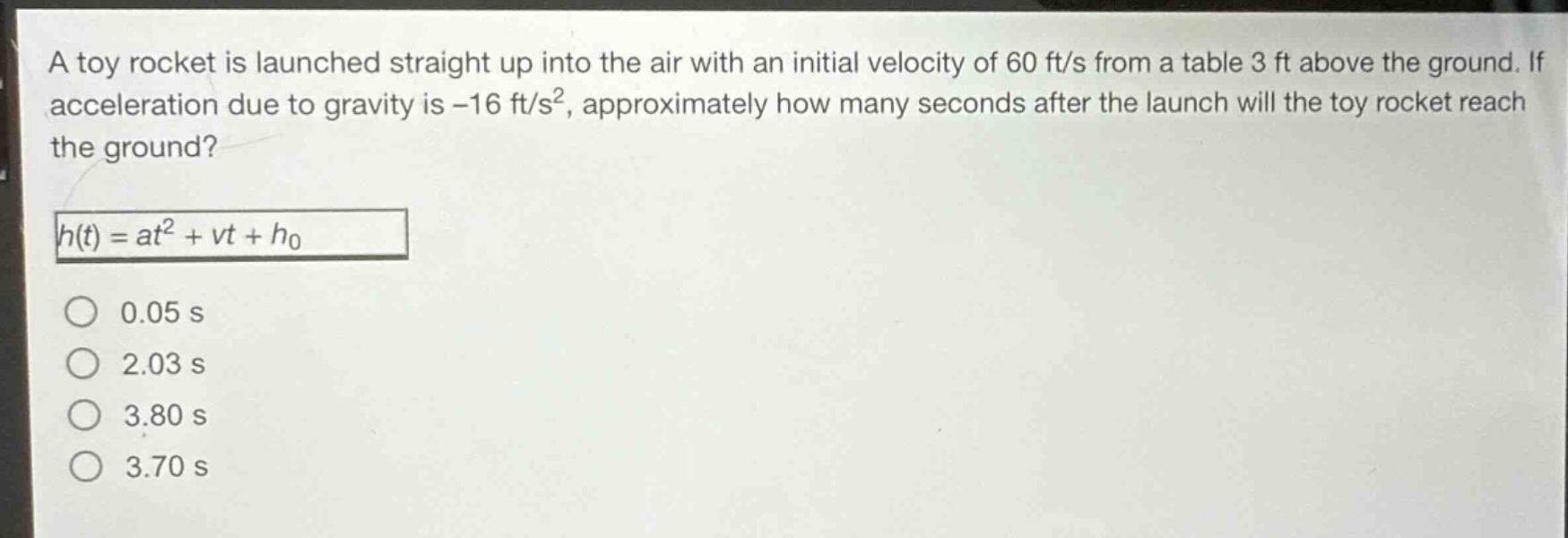
a toy rocket is launched straight up into the air with an initial velocity of 60 ft/s from a table 3 ft above the ground. if acceleration due to gravity is -16 ft/s², approximately how many seconds after the launch will the toy rocket reach the ground?\nh(t)=at² + vt + h₀\n0.05 s\n2.03 s\n3.80 s\n3.70 s
Answer
Explanation:
Step1: Identify the values
Given $a=-16$, $v = 60$, $h_0=3$, and $h(t)=0$ (when it reaches the ground). So the equation becomes $0=-16t^{2}+60t + 3$.
Step2: Use the quadratic formula
The quadratic formula for $ax^{2}+bx + c=0$ is $t=\frac{-b\pm\sqrt{b^{2}-4ac}}{2a}$. Here $a=-16$, $b = 60$, $c = 3$. First, calculate the discriminant $\Delta=b^{2}-4ac=(60)^{2}-4\times(-16)\times3=3600 + 192=3792$.
Step3: Calculate t
$t=\frac{-60\pm\sqrt{3792}}{2\times(-16)}=\frac{-60\pm61.58}{-32}$. We have two solutions for $t$: $t_1=\frac{-60 + 61.58}{-32}=\frac{1.58}{-32}<0$ (rejected as time can't be negative) and $t_2=\frac{-60-61.58}{-32}=\frac{-121.58}{-32}\approx3.80$.
Answer:
C. 3.80 s