what must be true of a force that causes an object to move in a circular motion?\nit acts parallel to the…
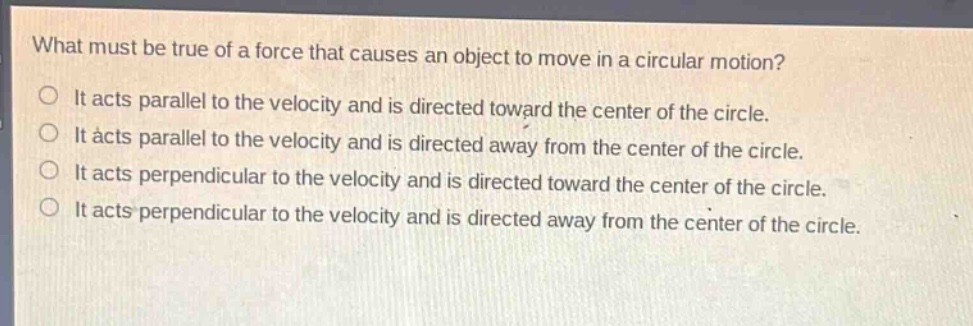
what must be true of a force that causes an object to move in a circular motion?\nit acts parallel to the velocity and is directed toward the center of the circle.\nit acts parallel to the velocity and is directed away from the center of the circle.\nit acts perpendicular to the velocity and is directed toward the center of the circle.\nit acts perpendicular to the velocity and is directed away from the center of the circle.
Answer
Answer:
C. It acts perpendicular to the velocity and is directed toward the center of the circle.
Brief Explanations:
In circular - motion, centripetal force acts perpendicular to the object's velocity, pulling it towards the center to maintain the circular path.