a tuning fork is vibrating the air around it. what best describes the waves produced by the tuning fork?\no…
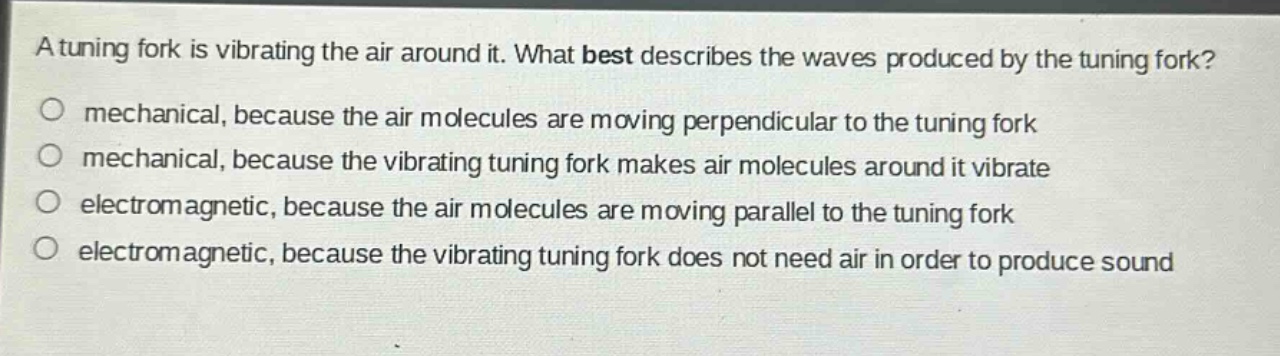
a tuning fork is vibrating the air around it. what best describes the waves produced by the tuning fork?\no mechanical, because the air molecules are moving perpendicular to the tuning fork\no mechanical, because the vibrating tuning fork makes air molecules around it vibrate\no electromagnetic, because the air molecules are moving parallel to the tuning fork\no electromagnetic, because the vibrating tuning fork does not need air in order to produce sound
Answer
Brief Explanations:
Mechanical waves require a medium to travel through. A tuning - fork vibrating air molecules is an example of mechanical wave production as it needs the air (a medium) to transfer the vibrations. Electromagnetic waves do not require a medium and are not produced by a tuning fork vibrating air. Also, the motion of air molecules in sound (produced by tuning fork) is not the determining factor for wave type.
Answer:
mechanical, because the vibrating tuning fork makes air molecules around it vibrate