two drivers narrowly avert a head - on collision. which driver decelerated faster in the first 4.5 seconds…
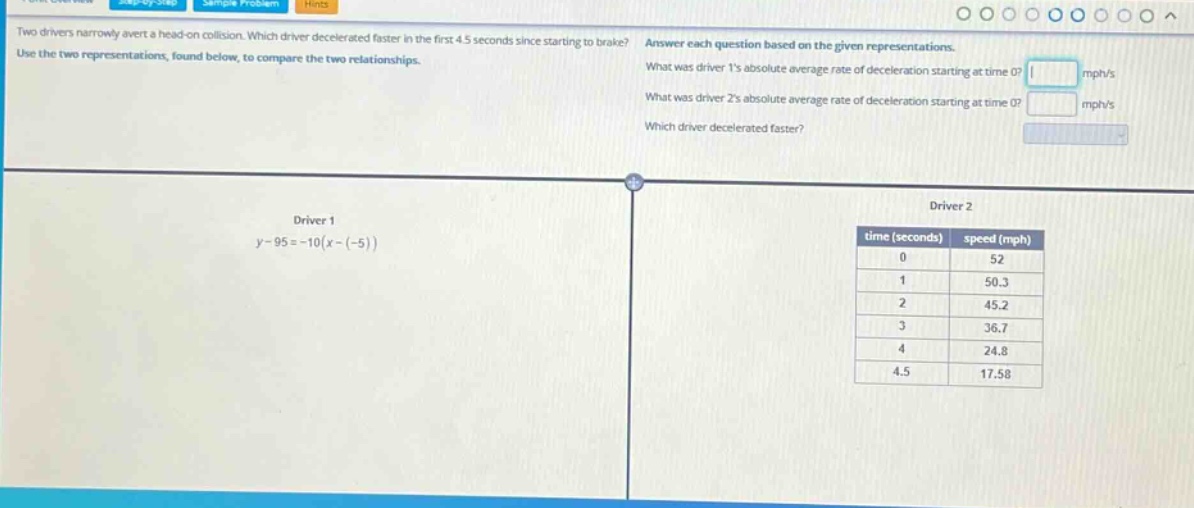
two drivers narrowly avert a head - on collision. which driver decelerated faster in the first 4.5 seconds since starting to brake? use the two representations, found below, to compare the two relationships. answer each question based on the given representations. what was driver 1s absolute average rate of deceleration starting at time 0? mph/s what was driver 2s absolute average rate of deceleration starting at time 0? mph/s which driver decelerated faster? driver 1 y - 95=-10(x - (-5)) driver 2 time (seconds) speed (mph) 0 52 1 50.3 2 45.2 3 36.7 4 24.8 4.5 17.58
Answer
Explanation:
Step1: Find Driver 1's deceleration rate
The equation for Driver 1 is in point - slope form $y - y_1=m(x - x_1)$. The slope $m=- 10$ represents the rate of change of speed with respect to time. The absolute value of the slope gives the absolute average rate of deceleration. So Driver 1's absolute average rate of deceleration starting at time $t = 0$ is $10$ mph/s.
Step2: Find Driver 2's deceleration rate
The average rate of change formula is $\frac{\Delta y}{\Delta x}=\frac{y_2 - y_1}{x_2 - x_1}$. For Driver 2, at $t = 0$, $y_1 = 52$ mph and at $t=4.5$, $y_2 = 17.58$ mph. Then $\frac{\Delta y}{\Delta x}=\frac{17.58 - 52}{4.5-0}=\frac{-34.42}{4.5}\approx - 7.65$ mph/s. The absolute value is approximately $7.65$ mph/s.
Step3: Compare the deceleration rates
Since $10>7.65$, Driver 1 decelerated faster.
Answer:
Driver 1's absolute average rate of deceleration starting at time 0: $10$ mph/s Driver 2's absolute average rate of deceleration starting at time 0: $7.65$ mph/s Which driver decelerated faster: Driver 1