two gears are adjusted so that the smaller gear drives the larger one, as shown in the figure. if the…
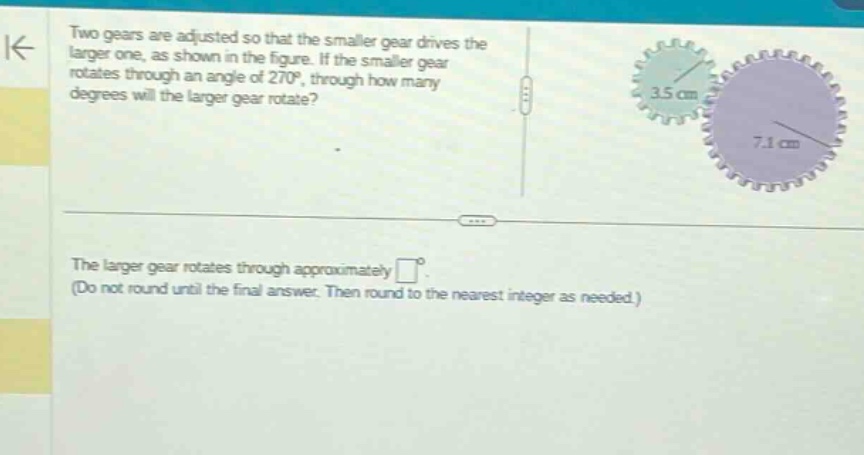
two gears are adjusted so that the smaller gear drives the larger one, as shown in the figure. if the smaller gear rotates through an angle of 270°, through how many degrees will the larger gear rotate? the larger gear rotates through approximately □°. (do not round until the final answer. then round to the nearest integer as needed.)
Answer
Explanation:
Step1: Recall arc - length formula
The arc - length formula is $s = r\theta$, where $s$ is the arc - length, $r$ is the radius, and $\theta$ is the angle in radians. Since the arc - lengths of the two gears in contact are equal when they mesh, we have $s_1=s_2$. Let $r_1 = 3.5$ cm be the radius of the smaller gear, $\theta_1$ be the angle of rotation of the smaller gear, $r_2=7.1$ cm be the radius of the larger gear, and $\theta_2$ be the angle of rotation of the larger gear. First, convert $\theta_1 = 270^{\circ}$ to radians. We know that $1^{\circ}=\frac{\pi}{180}$ radians, so $\theta_1=270\times\frac{\pi}{180}=\frac{3\pi}{2}$ radians.
Step2: Set up the arc - length equation
Since $s_1 = s_2$, we have $r_1\theta_1=r_2\theta_2$. Substitute $r_1 = 3.5$, $\theta_1=\frac{3\pi}{2}$, and $r_2 = 7.1$ into the equation: $3.5\times\frac{3\pi}{2}=7.1\times\theta_2$.
Step3: Solve for $\theta_2$
First, simplify the left - hand side of the equation: $3.5\times\frac{3\pi}{2}=\frac{10.5\pi}{2}$. Then, solve for $\theta_2$: $\theta_2=\frac{3.5\times\frac{3\pi}{2}}{7.1}=\frac{10.5\pi}{2\times7.1}=\frac{10.5\pi}{14.2}$. Convert $\theta_2$ back to degrees. We know that $\theta$ (in degrees) $=\theta$ (in radians) $\times\frac{180}{\pi}$. So $\theta_2=\frac{10.5\pi}{14.2}\times\frac{180}{\pi}=\frac{10.5\times180}{14.2}=\frac{1890}{14.2}\approx133^{\circ}$.
Answer:
$133$