two identical blocks are heated to different temperatures. the blocks are placed so that they touch, and…
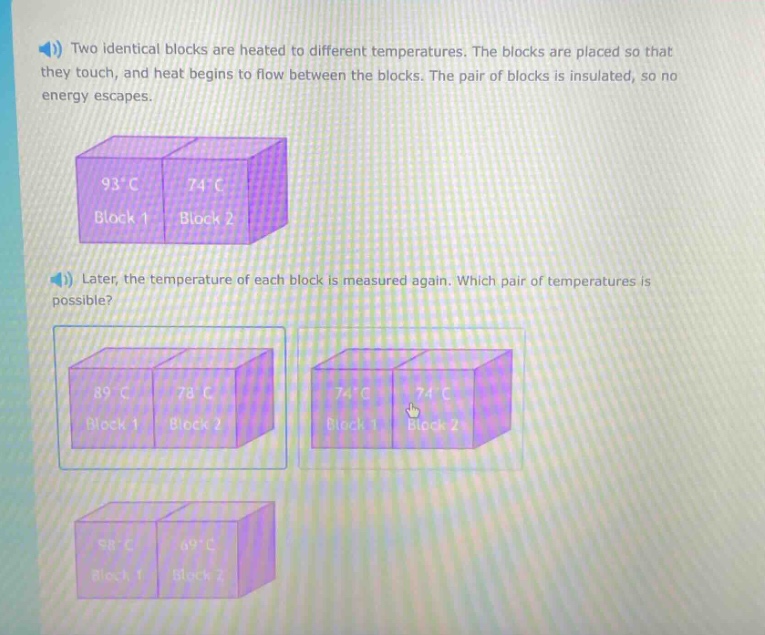
two identical blocks are heated to different temperatures. the blocks are placed so that they touch, and heat begins to flow between the blocks. the pair of blocks is insulated, so no energy escapes. later, the temperature of each block is measured again. which pair of temperatures is possible?
Answer
Explanation:
Step1: Understand heat - transfer principle
Heat flows from a hotter object to a colder object until thermal equilibrium is reached. The initial temperatures are 93°C for Block 1 and 74°C for Block 2. The final temperatures of the two - block system (insulated, so no energy loss to the surroundings) should be such that the temperature of the hotter block decreases and the temperature of the colder block increases. Also, the final temperatures of the two blocks should be equal at thermal equilibrium or be in a state where heat transfer is still in progress with the hotter block being hotter than the colder block.
Step2: Analyze each option
- Option 1: 89°C (Block 1) and 78°C (Block 2). The temperature of Block 1 has decreased from 93°C and the temperature of Block 2 has increased from 74°C, and Block 1 is still hotter than Block 2. This is possible during the heat - transfer process before thermal equilibrium is reached.
- Option 2: 74°C (Block 1) and 74°C. This would be the case when thermal equilibrium is reached, but since the question asks for a non - equilibrium state (as it just asks for a possible pair during the process), this is also a valid option during the later measurement if equilibrium has been achieved.
- Option 3: 98°C (Block 1) and 69°C (Block 2). The temperature of Block 1 has increased and the temperature of Block 2 has decreased, which violates the principle of heat transfer from hot to cold. So this option is not possible.
Answer:
The possible pairs are 89°C (Block 1) and 78°C (Block 2), 74°C (Block 1) and 74°C (Block 2)