two identical blocks are heated to different temperatures. the blocks are placed so that they touch, and…
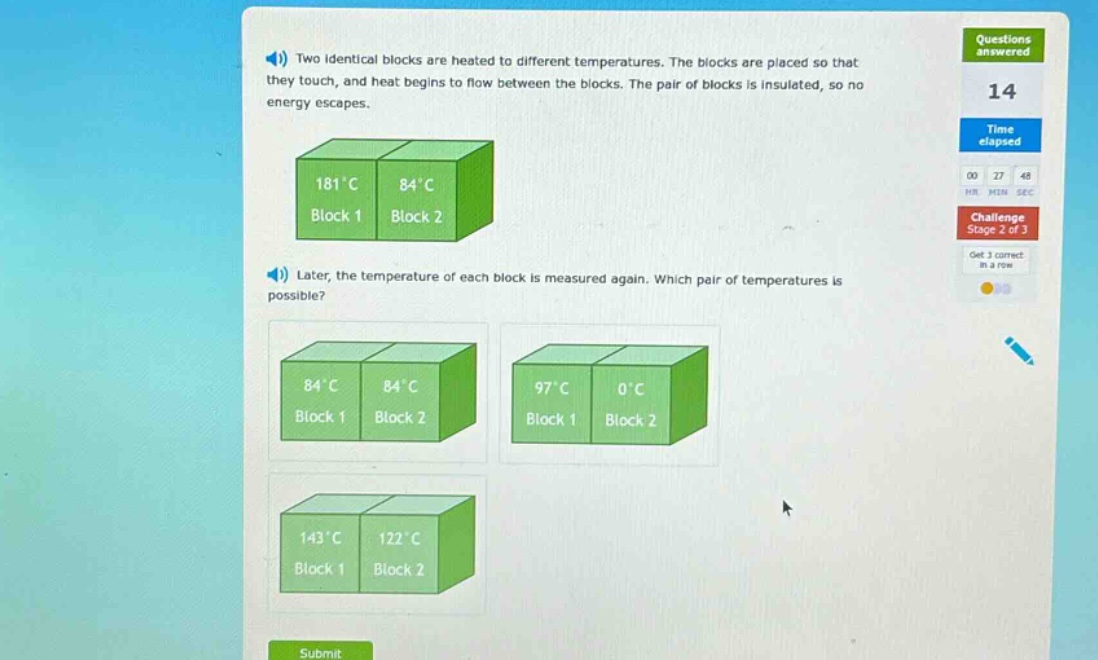
two identical blocks are heated to different temperatures. the blocks are placed so that they touch, and heat begins to flow between the blocks. the pair of blocks is insulated, so no energy escapes.\nlater, the temperature of each block is measured again. which pair of temperatures is possible?
Answer
Explanation:
Step1: Understand heat - transfer principle
Heat flows from a higher - temperature object to a lower - temperature object until thermal equilibrium is reached. The initial temperatures are $181^{\circ}C$ for Block 1 and $84^{\circ}C$ for Block 2. The final temperatures of the two blocks must be such that Block 1 cools down and Block 2 heats up, and they move towards a common temperature (but may not necessarily reach it if the time is not sufficient).
Step2: Analyze each option
- Option 1 ($84^{\circ}C$, $84^{\circ}C$): Block 1 cannot cool down to the initial temperature of Block 2 while Block 2 remains at its initial temperature, so this is not possible.
- Option 2 ($97^{\circ}C$, $0^{\circ}C$): Block 2 cannot cool down to $0^{\circ}C$ as heat is flowing into it from Block 1, so this is not possible.
- Option 3 ($143^{\circ}C$, $122^{\circ}C$): Block 1 has cooled down from $181^{\circ}C$ and Block 2 has heated up from $84^{\circ}C$, which is consistent with the heat - transfer process.
Answer:
The pair of temperatures $143^{\circ}C$ for Block 1 and $122^{\circ}C$ for Block 2 is possible.