two objects with different masses and different velocities have the same momentum. what must be true of the…
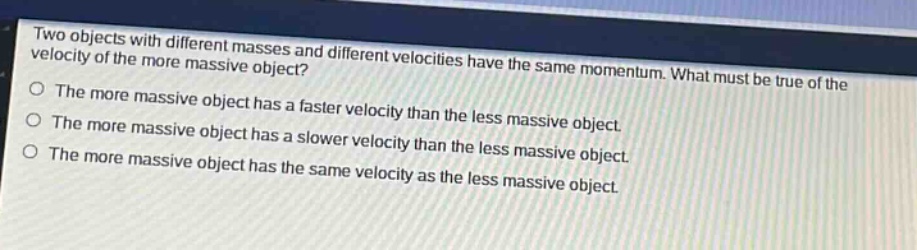
two objects with different masses and different velocities have the same momentum. what must be true of the velocity of the more massive object?\nthe more massive object has a faster velocity than the less massive object.\nthe more massive object has a slower velocity than the less massive object.\nthe more massive object has the same velocity as the less massive object.
Answer
Explanation:
Step1: Recall momentum formula
Momentum $p = mv$, where $m$ is mass and $v$ is velocity.
Step2: Set up equal - momentum equation
Let $m_1$ and $v_1$ be the mass and velocity of one object, and $m_2$ and $v_2$ be the mass and velocity of the other object. Given $p_1 = p_2$, so $m_1v_1=m_2v_2$.
Step3: Analyze the relationship
If $m_1>m_2$, then to keep $m_1v_1 = m_2v_2$, we must have $v_1<v_2$. That is, the more massive object has a slower velocity than the less massive object.
Answer:
The more massive object has a slower velocity than the less massive object.