two parallel plates have an area of 0.00100 m². how much charge must you place on them to create a 1000 n/c…
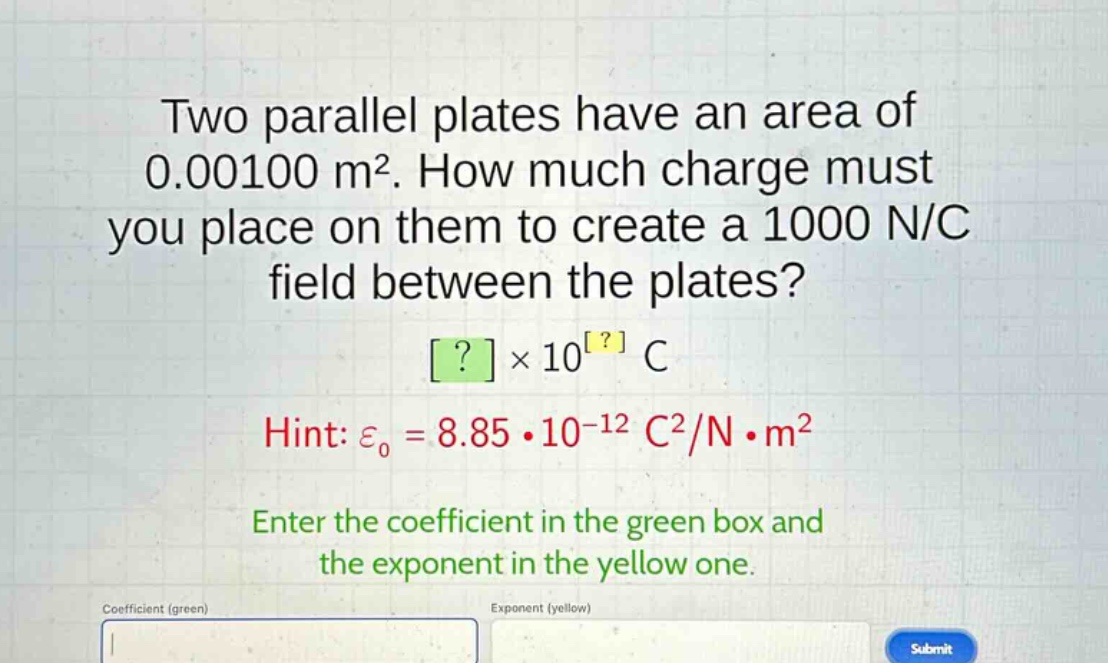
two parallel plates have an area of 0.00100 m². how much charge must you place on them to create a 1000 n/c field between the plates? ?×10^? c hint: ε₀ = 8.85·10⁻¹² c²/n·m² enter the coefficient in the green box and the exponent in the yellow one.
Answer
Explanation:
Step1: Recall the formula for electric - field between parallel plates
The electric - field between parallel plates is given by $E=\frac{\sigma}{\epsilon_0}$, where $\sigma=\frac{Q}{A}$ is the surface charge density, $Q$ is the charge on the plates, $A$ is the area of the plates, and $\epsilon_0 = 8.85\times10^{-12}\ C^{2}/N\cdot m^{2}$ is the permittivity of free space. We can rewrite the formula for $Q$ as $Q = E\times A\times\epsilon_0$.
Step2: Substitute the given values
We are given that $E = 1000\ N/C$, $A=0.00100\ m^{2}$, and $\epsilon_0 = 8.85\times10^{-12}\ C^{2}/N\cdot m^{2}$. $Q=(1000\ N/C)\times(0.00100\ m^{2})\times(8.85\times10^{-12}\ C^{2}/N\cdot m^{2})$ $Q = 8.85\times10^{-12}\times1000\times0.00100\ C$ $Q=8.85\times10^{-12}\ C$
Answer:
Coefficient (green): 8.85 Exponent (yellow): - 12