two protons and two neutrons are released as a result of this reaction.\n$_{86}^{222}rn\\rightarrow_{84}^{218…
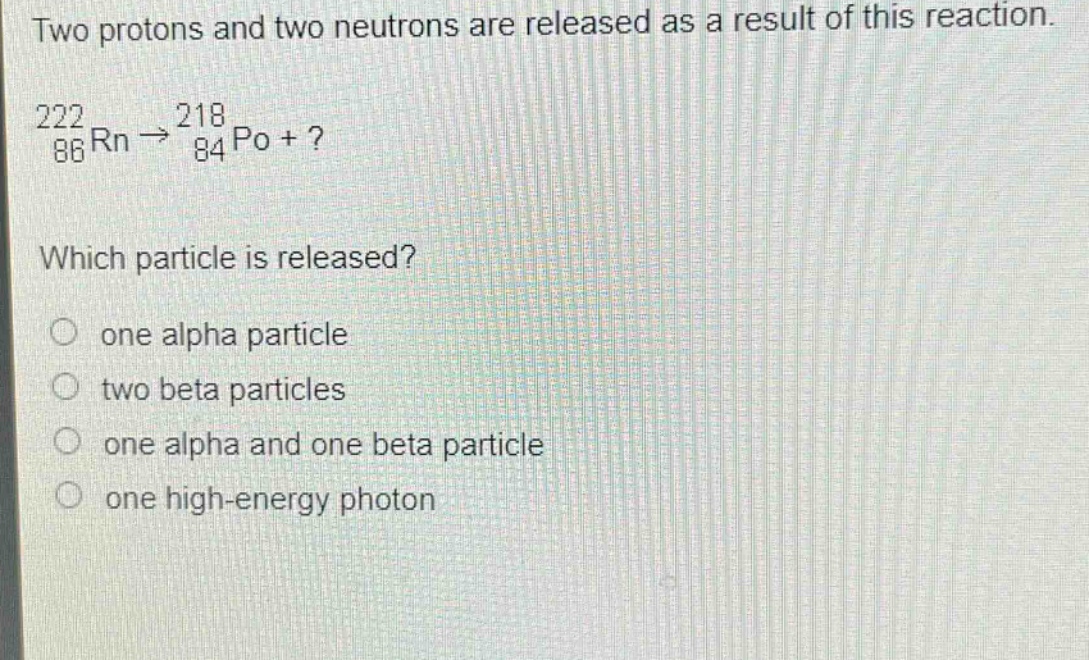
two protons and two neutrons are released as a result of this reaction.\n$_{86}^{222}rn\\rightarrow_{84}^{218}po +?$ \nwhich particle is released?\none alpha particle\ntwo beta particles\none alpha and one beta particle\none high - energy photon
Answer
Explanation:
Step1: Analyze mass - number change
The mass - number of $^{222}{86}Rn$ is 222 and of $^{218}{84}Po$ is 218. The change in mass - number $\Delta A=222 - 218 = 4$.
Step2: Analyze atomic - number change
The atomic - number of $^{222}{86}Rn$ is 86 and of $^{218}{84}Po$ is 84. The change in atomic - number $\Delta Z=86 - 84 = 2$.
Step3: Recall particle properties
An alpha particle ($\alpha$) has a mass - number of 4 and an atomic - number of 2, represented as $^{4}{2}He$. A beta particle ($\beta$) has a mass - number of 0 and an atomic - number of - 1, represented as $^{0}{- 1}e$. A high - energy photon ($\gamma$) has a mass - number of 0 and an atomic - number of 0, represented as $^{0}_{0}\gamma$.
Answer:
A. one alpha particle