two rocks are launched into the air.\n• the height of rock a is given by function f, where f(t)=4 + 30t…
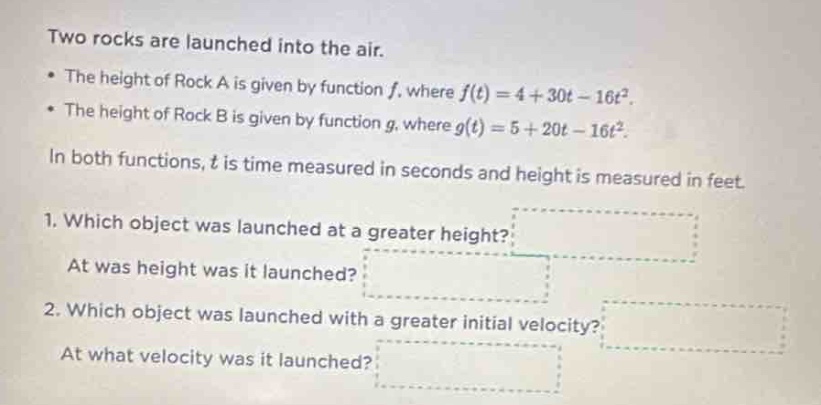
two rocks are launched into the air.\n• the height of rock a is given by function f, where f(t)=4 + 30t - 16t².\n• the height of rock b is given by function g, where g(t)=5 + 20t - 16t².\nin both functions, t is time measured in seconds and height is measured in feet.\n1. which object was launched at a greater height?\nat was height was it launched?\n2. which object was launched with a greater initial velocity?\nat what velocity was it launched?
Answer
Explanation:
Step1: Find the initial height of each rock
Initial height is when (t = 0). For Rock A, substitute (t=0) into (f(t)): (f(0)=4 + 30\times0-16\times0^{2}=4). For Rock B, substitute (t = 0) into (g(t)): (g(0)=5+20\times0 - 16\times0^{2}=5). Since (5>4), Rock B was launched at a greater height.
Step2: Find the initial velocity of each rock
The velocity - function is the derivative of the height - function. The derivative of (f(t)=4 + 30t-16t^{2}) is (f^\prime(t)=30 - 32t). The initial velocity of Rock A is (f^\prime(0)=30) feet per second. The derivative of (g(t)=5 + 20t-16t^{2}) is (g^\prime(t)=20 - 32t). The initial velocity of Rock B is (g^\prime(0)=20) feet per second. Since (30>20), Rock A was launched with a greater initial velocity.
Answer:
- Rock B, 5 feet
- Rock A, 30 feet per second