two samples of carbon come into contact. a heat transfer will occur between sample a and sample b. what must…
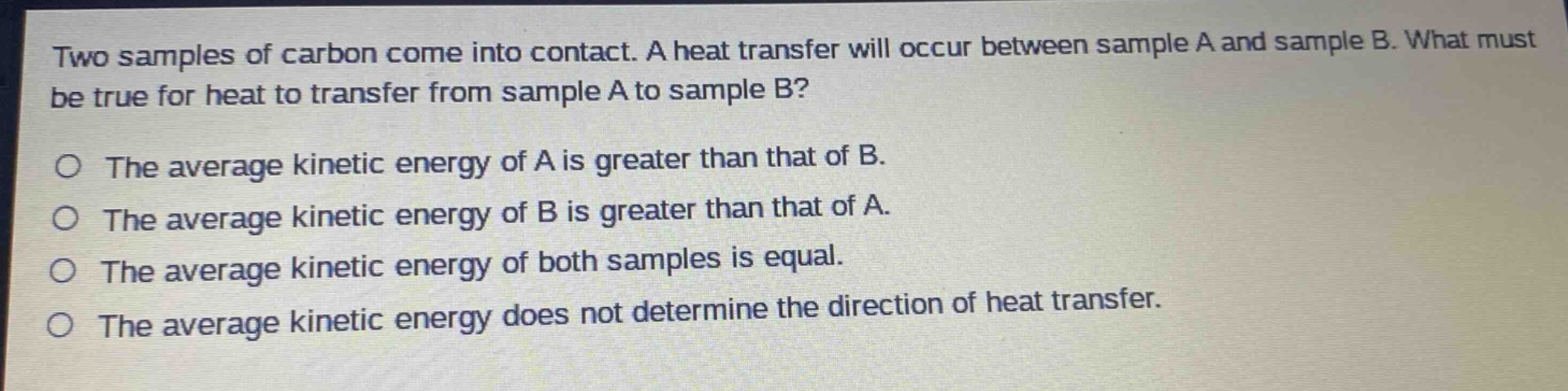
two samples of carbon come into contact. a heat transfer will occur between sample a and sample b. what must be true for heat to transfer from sample a to sample b?\no the average kinetic energy of a is greater than that of b.\no the average kinetic energy of b is greater than that of a.\no the average kinetic energy of both samples is equal.\no the average kinetic energy does not determine the direction of heat transfer.
Answer
Answer:
The average kinetic energy of A is greater than that of B.
Explanation:
Step1: Definir transferencia de calor
La calor se transfiere de un cuerpo a otro cuando existe una diferencia de temperatura. La temperatura es una medida de la energía cinética media de las partículas del cuerpo.
Step2: Relación entre temperatura y energía cinética media
Las partículas en un cuerpo con mayor temperatura tienen una energía cinética media mayor. Cuando dos cuerpos entran en contacto, la calor se transfiere del cuerpo de mayor temperatura (mayor energía cinética media de sus partículas) al cuerpo de menor temperatura (menor energía cinética media de sus partículas). Entonces, para que la calor se transfiera de la muestra A a la muestra B, la energía cinética media de A debe ser mayor que la de B.