two satellites, x and y, are orbiting earth. satellite x is 1.2×10^6 m from earth, and satellite y is…
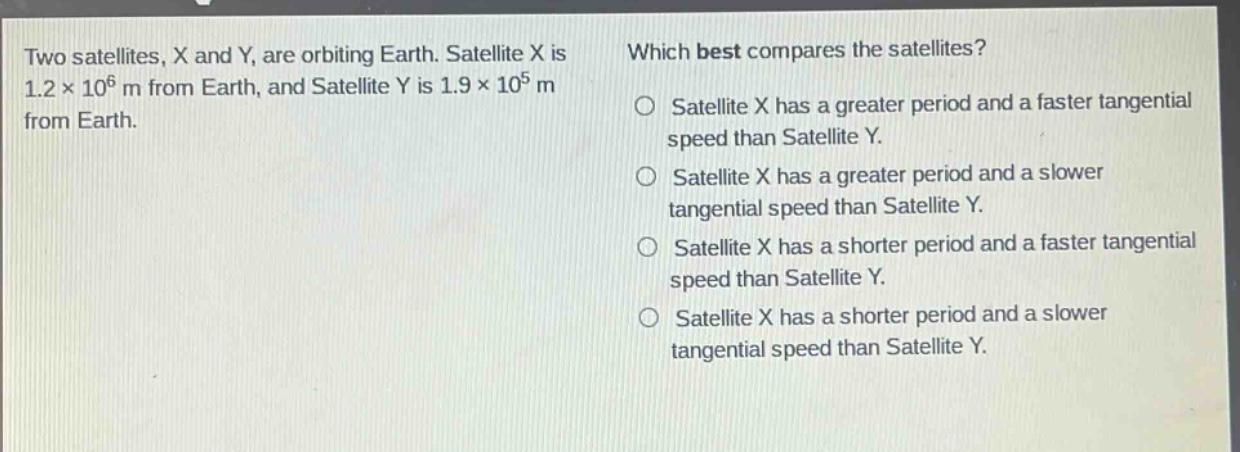
two satellites, x and y, are orbiting earth. satellite x is 1.2×10^6 m from earth, and satellite y is 1.9×10^5 m from earth. which best compares the satellites? satellite x has a greater period and a faster tangential speed than satellite y. satellite x has a greater period and a slower tangential speed than satellite y. satellite x has a shorter period and a faster tangential speed than satellite y. satellite x has a shorter period and a slower tangential speed than satellite y.
Answer
Answer:
Satellite X has a greater period and a slower tangential speed than Satellite Y.
Explanation:
Step1: Recall orbital - period formula
The orbital period (T) of a satellite around the Earth is given by (T = 2\pi\sqrt{\frac{r^{3}}{GM}}), where (r) is the radius of the orbit, (G) is the gravitational constant, and (M) is the mass of the Earth. Since (T\propto\sqrt{r^{3}}), and (r_X=1.2\times 10^{6}\text{ m}), (r_Y = 1.9\times 10^{5}\text{ m}), with (r_X>r_Y), Satellite X has a greater period.
Step2: Recall tangential - speed formula
The tangential speed (v) of a satellite in orbit is given by (v=\sqrt{\frac{GM}{r}}). Since (v\propto\frac{1}{\sqrt{r}}), and (r_X > r_Y), the tangential speed of Satellite X is less than that of Satellite Y. So Satellite X has a greater period and a slower tangential speed than Satellite Y.