type the correct answer in the box. express your answer to three significant figures.\nthe half - life of…
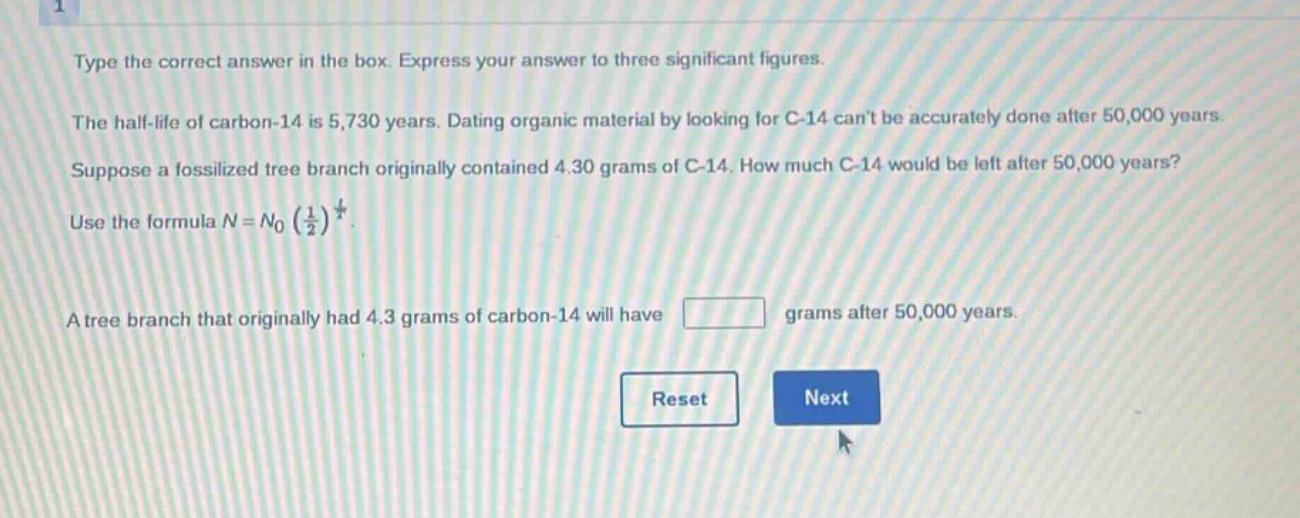
type the correct answer in the box. express your answer to three significant figures.\nthe half - life of carbon - 14 is 5,730 years. dating organic material by looking for c - 14 cant be accurately done after 50,000 years.\nsuppose a fossilized tree branch originally contained 4.30 grams of c - 14. how much c - 14 would be left after 50,000 years?\nuse the formula $n = n_0(\frac{1}{2})^{\frac{t}{t}}$.\na tree branch that originally had 4.3 grams of carbon - 14 will have grams after 50,000 years.
Answer
Explanation:
Step1: Identify the values
$N_0 = 4.30$ grams, $t = 50000$ years, $T=5730$ years.
Step2: Substitute into the formula
$N = N_0(\frac{1}{2})^{\frac{t}{T}}=4.30\times(\frac{1}{2})^{\frac{50000}{5730}}$.
Step3: Calculate the exponent
$\frac{50000}{5730}\approx8.726$.
Step4: Calculate the power of $\frac{1}{2}$
$(\frac{1}{2})^{8.726}\approx0.00207$.
Step5: Calculate the remaining amount
$N = 4.30\times0.00207 = 0.00889$ grams.
Answer:
$0.00889$