type the correct answer in each box. round your answer to the nearest hundredth.\nthe bob (weight) at the…
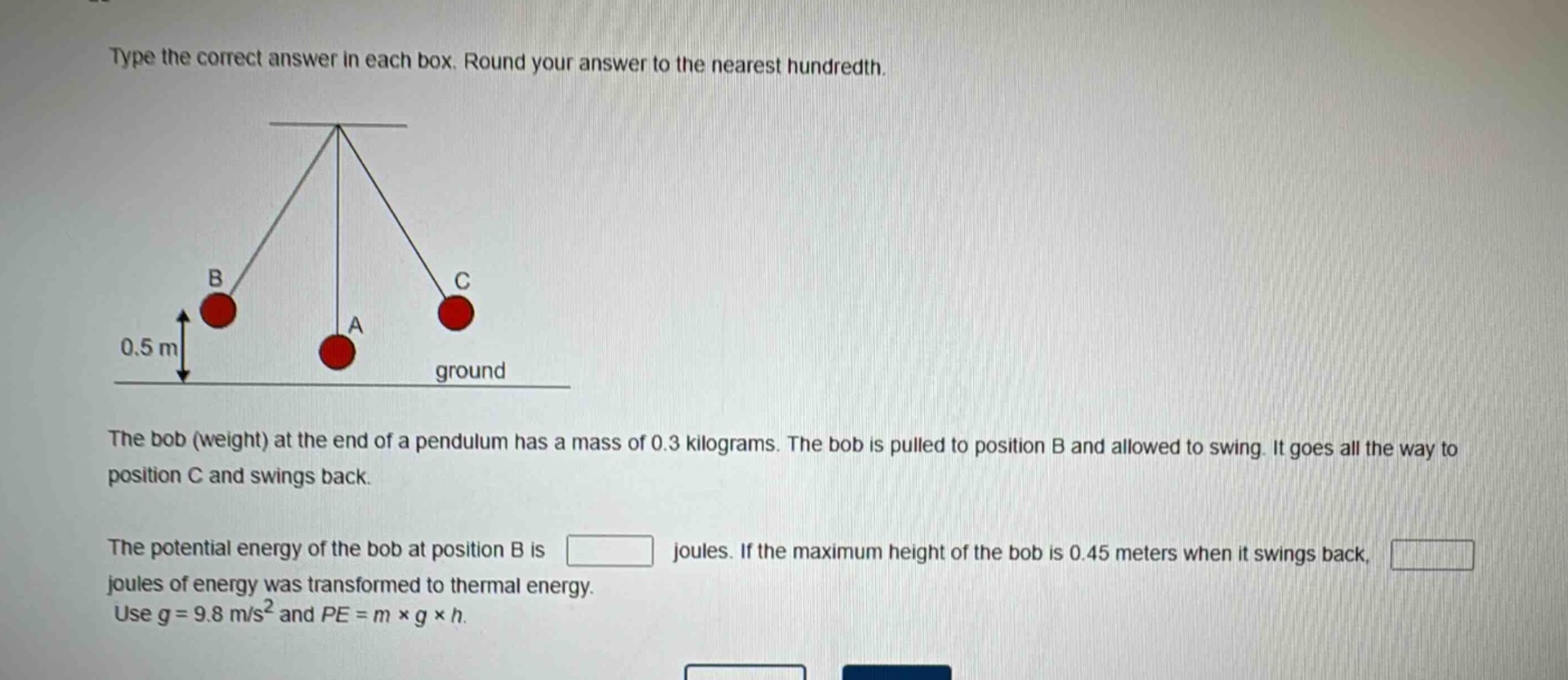
type the correct answer in each box. round your answer to the nearest hundredth.\nthe bob (weight) at the end of a pendulum has a mass of 0.3 kilograms. the bob is pulled to position b and allowed to swing. it goes all the way to position c and swings back.\nthe potential energy of the bob at position b is joules. if the maximum height of the bob is 0.45 meters when it swings back, joules of energy was transformed to thermal energy.\nuse g = 9.8 m/s² and pe = m × g × h.
Answer
Answer:
1.47; 0.15
Explanation:
Step1: Calculate potential energy at B
Given $m = 0.3$ kg, $g=9.8$ m/s², $h = 0.5$ m. Using $PE=m\times g\times h$, we have $PE=0.3\times9.8\times0.5=\frac{0.3\times9.8\times0.5}{1}=1.47$ J.
Step2: Calculate potential energy at new - height
For $h'=0.45$ m, $m = 0.3$ kg, $g = 9.8$ m/s², $PE'=m\times g\times h'=0.3\times9.8\times0.45 = 1.323$ J.
Step3: Calculate energy transformed to thermal
Initial potential energy at B is 1.47 J. Final potential energy is 1.323 J. Energy transformed to thermal $E=1.47 - 1.323=0.147\approx0.15$ J.