type the correct answer in the box. round your answer to the nearest tenth. two forces, $f_1$ and $f_2$, are…
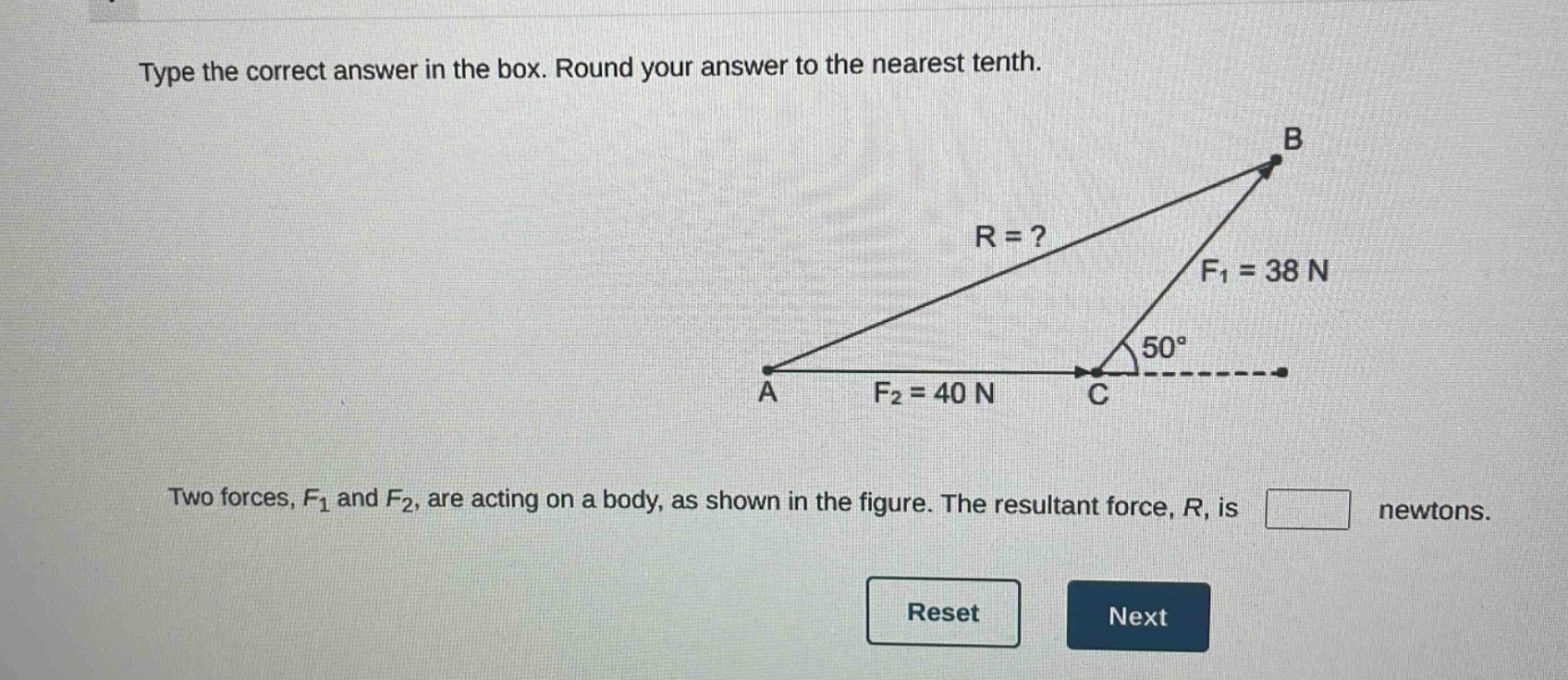
type the correct answer in the box. round your answer to the nearest tenth. two forces, $f_1$ and $f_2$, are acting on a body, as shown in the figure. the resultant force, $r$, is newtons.
Answer
Explanation:
Step1: Apply the law of cosines
The law of cosines for finding the magnitude of the resultant of two - forces $\vec{F}_1$ and $\vec{F}_2$ with an included angle $\theta$ is $R=\sqrt{F_1^{2}+F_2^{2}+2F_1F_2\cos\theta}$. Here, $F_1 = 38$ N, $F_2=40$ N, and $\theta = 130^{\circ}$ (since the angle between the two - force vectors in the formula sense is $180 - 50=130^{\circ}$).
Step2: Calculate the squares and the cosine term
$F_1^{2}=38^{2}=1444$, $F_2^{2}=40^{2}=1600$, and $\cos\theta=\cos130^{\circ}\approx - 0.6428$. Then $2F_1F_2\cos\theta=2\times38\times40\times(-0.6428)=-1971.712$.
Step3: Calculate the value inside the square - root
$F_1^{2}+F_2^{2}+2F_1F_2\cos\theta=1444 + 1600-1971.712=1072.288$.
Step4: Find the magnitude of the resultant force
$R=\sqrt{1072.288}\approx32.7$ N.
Answer:
$32.7$