which would ultimately cause the armature in an electric motor to spin?\nthe current in the armature…
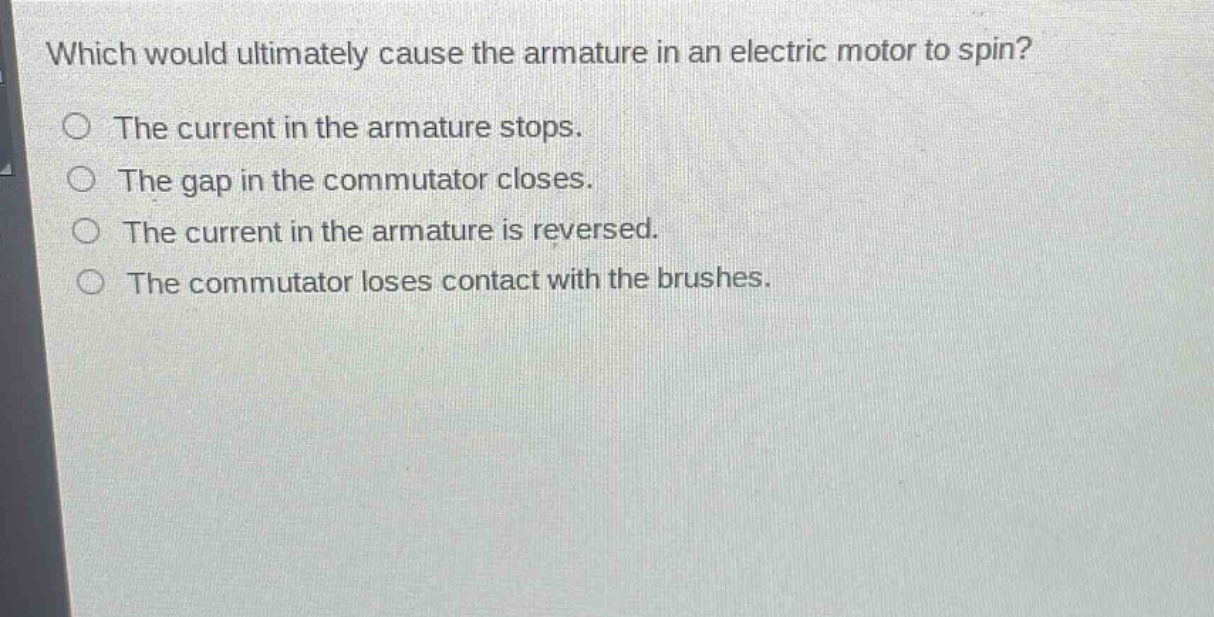
which would ultimately cause the armature in an electric motor to spin?\nthe current in the armature stops.\nthe gap in the commutator closes.\nthe current in the armature is reversed.\nthe commutator loses contact with the brushes.
Answer
Brief Explanations:
In an electric motor, the commutator reverses the current in the armature coil. This reversal of current changes the direction of the magnetic force acting on the coil. According to the principle of the electric motor (based on the interaction between magnetic fields and current - carrying conductors), when the direction of the magnetic force changes periodically, it causes the armature to spin continuously.
- If the current in the armature stops ((I = 0)), by (F=BIL\sin\theta) (where (F) is the magnetic force, (B) is the magnetic field, (L) is the length of the conductor in the magnetic field, and (\theta) is the angle between the conductor and the magnetic field), the magnetic force (F = 0), and the armature will not spin.
- The commutator has gaps to facilitate the reversal of current. Closing the gap in an improper way (not in the normal operation of commutation) is not the cause of armature spin.
- If the commutator loses contact with the brushes, there will be no current in the armature ((I = 0)) (similar to the first - wrong option case), and the armature will not spin.
Answer:
The current in the armature is reversed.