use the drop - down menus to identify the variables for the second hypothesis. hypothesis #2: as you build…
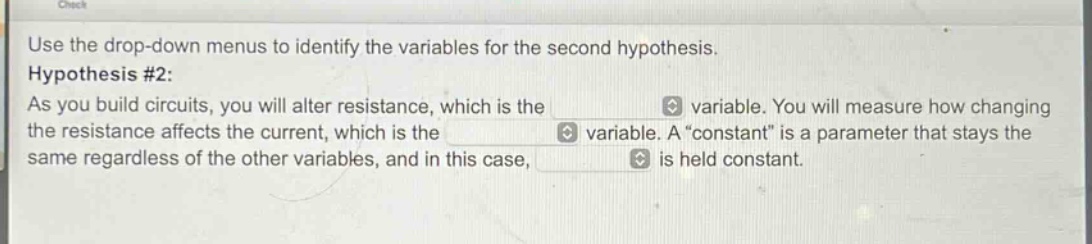
use the drop - down menus to identify the variables for the second hypothesis. hypothesis #2: as you build circuits, you will alter resistance, which is the variable. you will measure how changing the resistance affects the current, which is the variable. a “constant” is a parameter that stays the same regardless of the other variables, and in this case, is held constant.
Answer
Brief Explanations:
In an experiment, the independent variable is what is deliberately changed. Here, resistance is altered, so it's the independent variable. The dependent variable is what is measured and is affected by the independent variable, so current is the dependent variable. In Ohm's law ($V = IR$), when studying the relationship between resistance and current, voltage is often held constant.
Answer:
Independent variable: Resistance Dependent variable: Current Constant: Voltage