do not use negatives for used values when entering numbers in the chart below.\nwhat voltage is left after…
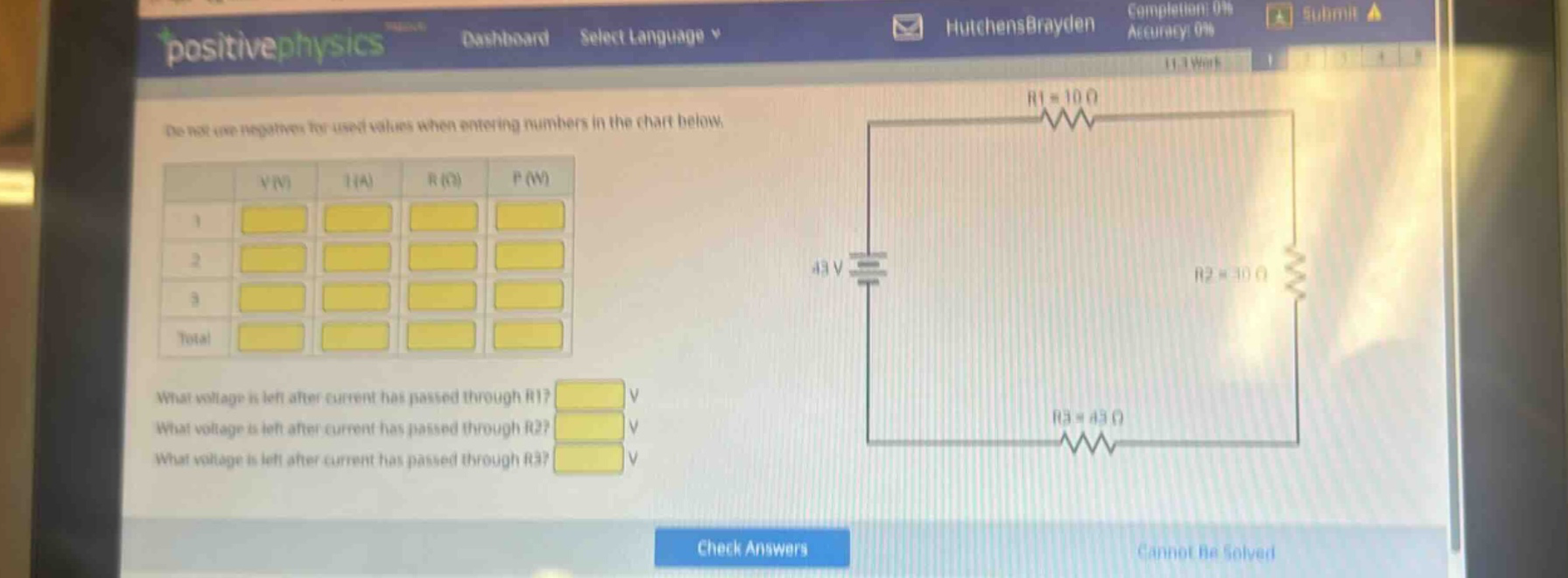
do not use negatives for used values when entering numbers in the chart below.\nwhat voltage is left after current has passed through r1?\nwhat voltage is left after current has passed through r2?\nwhat voltage is left after current has passed through r3?
Answer
Explanation:
Step1: Calculate total resistance
The resistors are in series. So, $R_{total}=R1 + R2+R3=10\Omega+10\Omega + 43\Omega=63\Omega$.
Step2: Calculate total current using Ohm's law
Ohm's law is $I=\frac{V}{R}$. Given $V = 43V$ and $R = R_{total}=63\Omega$, so $I=\frac{43V}{63\Omega}\approx0.683A$.
Step3: Calculate voltage across each resistor
For $R1$: Using $V = IR$, $V1=I\times R1=0.683A\times10\Omega = 6.83V$. For $R2$: $V2=I\times R2=0.683A\times10\Omega = 6.83V$. For $R3$: $V3=I\times R3=0.683A\times43\Omega\approx29.37V$.
Step4: Calculate voltage left after each resistor
Voltage left after $R1$: $V_{left1}=43V - 6.83V = 36.17V$. Voltage left after $R2$: $V_{left2}=36.17V - 6.83V = 29.34V$. Voltage left after $R3$: $V_{left3}=29.34V - 29.37V = 0V$.
For the table:
| V (V) | I (A) | R ($\Omega$) | P (W) | |
|---|---|---|---|---|
| 1 | 6.83 | 0.683 | 10 | $P1=V1\times I = 6.83V\times0.683A\approx4.67W$ |
| 2 | 6.83 | 0.683 | 10 | $P2=V2\times I = 6.83V\times0.683A\approx4.67W$ |
| 3 | 29.37 | 0.683 | 43 | $P3=V3\times I = 29.37V\times0.683A\approx20.06W$ |
| Total | 43 | 0.683 | 63 | $P_{total}=V_{total}\times I = 43V\times0.683A\approx29.37W$ |
Answer:
Voltage left after $R1$: $36.17V$ Voltage left after $R2$: $29.34V$ Voltage left after $R3$: $0V$ Table values as shown above.