use the parallelogram rule to find the magnitude of the resultant force for the two forces shown in the…
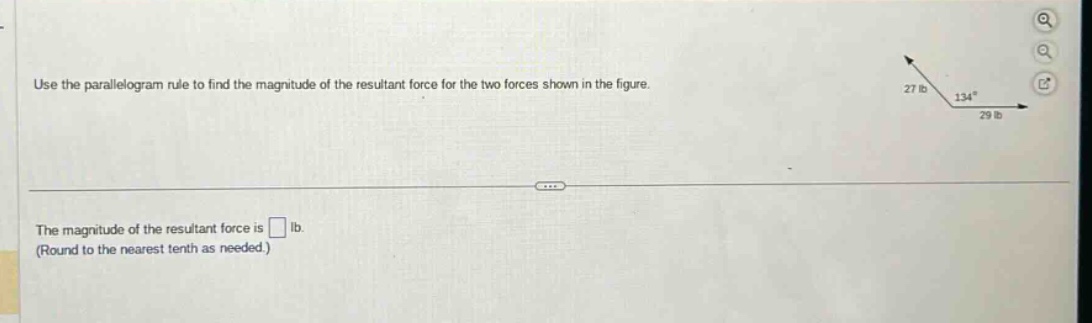
use the parallelogram rule to find the magnitude of the resultant force for the two forces shown in the figure.\nthe magnitude of the resultant force is (square) lb.\n(round to the nearest tenth as needed.)
Answer
Explanation:
Step1: Recall the law of cosines for resultant force
If two forces $F_1$ and $F_2$ act at an angle $\theta$ to each other, the magnitude of the resultant force $R$ is given by $R=\sqrt{F_1^{2}+F_2^{2}-2F_1F_2\cos(180 - \theta)}$. Here $F_1 = 27$ lb, $F_2=29$ lb and $\theta = 134^{\circ}$. Since $\cos(180 - \alpha)=-\cos\alpha$, the formula becomes $R=\sqrt{F_1^{2}+F_2^{2}+2F_1F_2\cos\theta}$.
Step2: Substitute the values
Substitute $F_1 = 27$, $F_2 = 29$ and $\theta=134^{\circ}$ into the formula. $R=\sqrt{27^{2}+29^{2}+2\times27\times29\times\cos(134^{\circ})}$. First, calculate the squares and the product - cosine term: $27^{2}=729$, $29^{2}=841$, and $2\times27\times29\times\cos(134^{\circ})=2\times27\times29\times(- 0.71934)=2\times27\times29\times(-0.71934)\approx - 1143.7$. Then $R=\sqrt{729 + 841-1143.7}=\sqrt{1570 - 1143.7}=\sqrt{426.3}$.
Step3: Calculate the square - root and round
$\sqrt{426.3}\approx20.6$.
Answer:
$20.6$