use the text to compare and contrast galaxies and nebulae. nebulae and galaxies are two types of celestial…
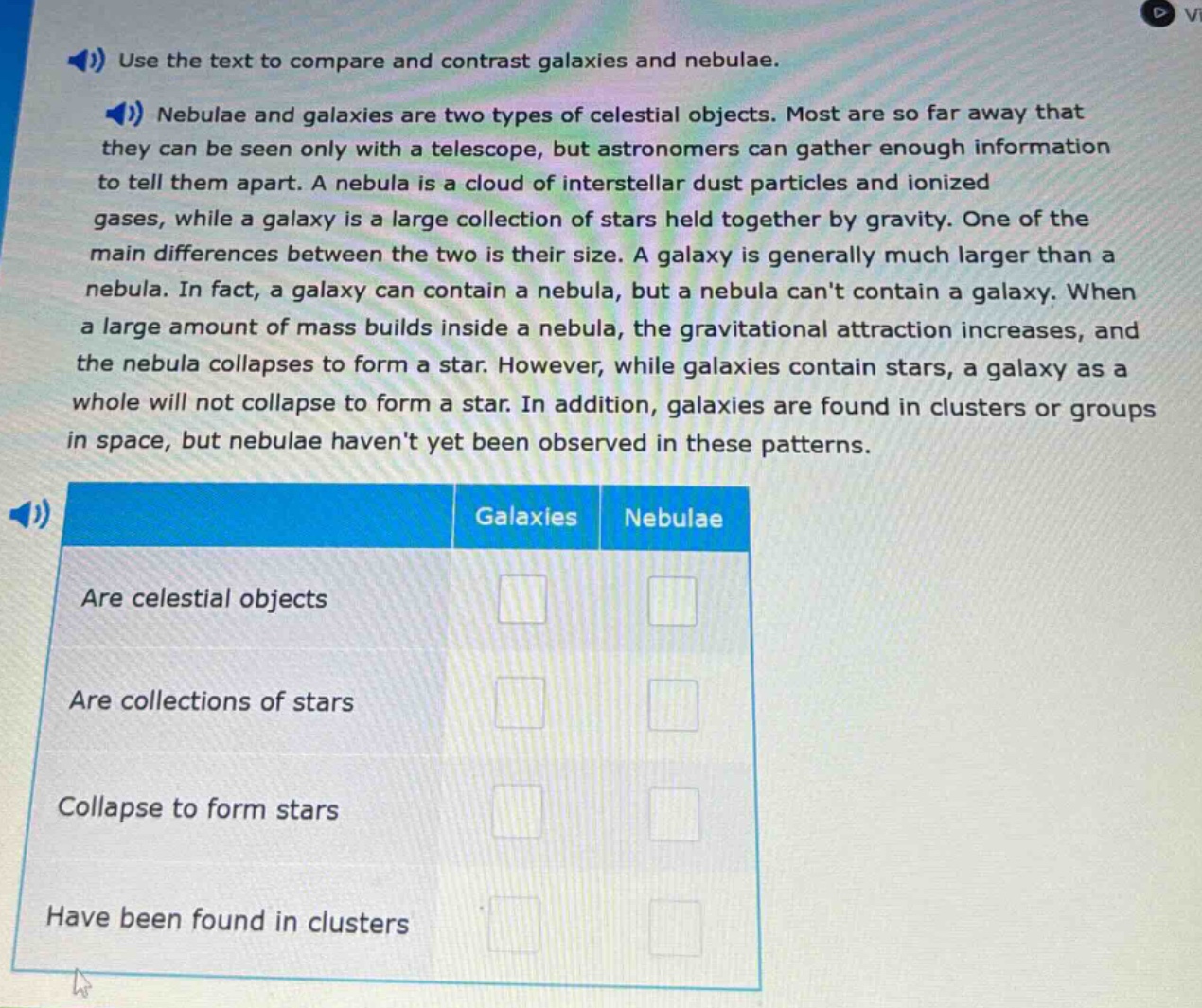
use the text to compare and contrast galaxies and nebulae. nebulae and galaxies are two types of celestial objects. most are so far away that they can be seen only with a telescope, but astronomers can gather enough information to tell them apart. a nebula is a cloud of interstellar dust particles and ionized gases, while a galaxy is a large collection of stars held together by gravity. one of the main differences between the two is their size. a galaxy is generally much larger than a nebula. in fact, a galaxy can contain a nebula, but a nebula cant contain a galaxy. when a large amount of mass builds inside a nebula, the gravitational attraction increases, and the nebula collapses to form a star. however, while galaxies contain stars, a galaxy as a whole will not collapse to form a star. in addition, galaxies are found in clusters or groups in space, but nebulae havent yet been observed in these patterns. galaxies nebulae are celestial objects are collections of stars collapse to form stars have been found in clusters
Answer
Brief Explanations:
- Ambas son objetos celestes, según el texto.
- Las galaxias son grandes colecciones de estrellas, mientras que las nebulosas son nubes de polvo interestelar e gases ionizados, no colecciones de estrellas.
- Las nebulosas se pueden colapsar para formar estrellas, pero las galaxias no se colapsan enteras para formar estrellas.
- Las galaxias se encuentran en cúmulos o grupos, mientras que las nebulosas no se han observado en estos patrones.
Answer:
- Are celestial objects: Galaxies: Sí, Nebulae: Sí
- Are collections of stars: Galaxies: Sí, Nebulae: No
- Collapse to form stars: Galaxies: No, Nebulae: Sí
- Have been found in clusters: Galaxies: Sí, Nebulae: No