using the handy dandy super deluxe new york state earth science reference tables, answer the following…
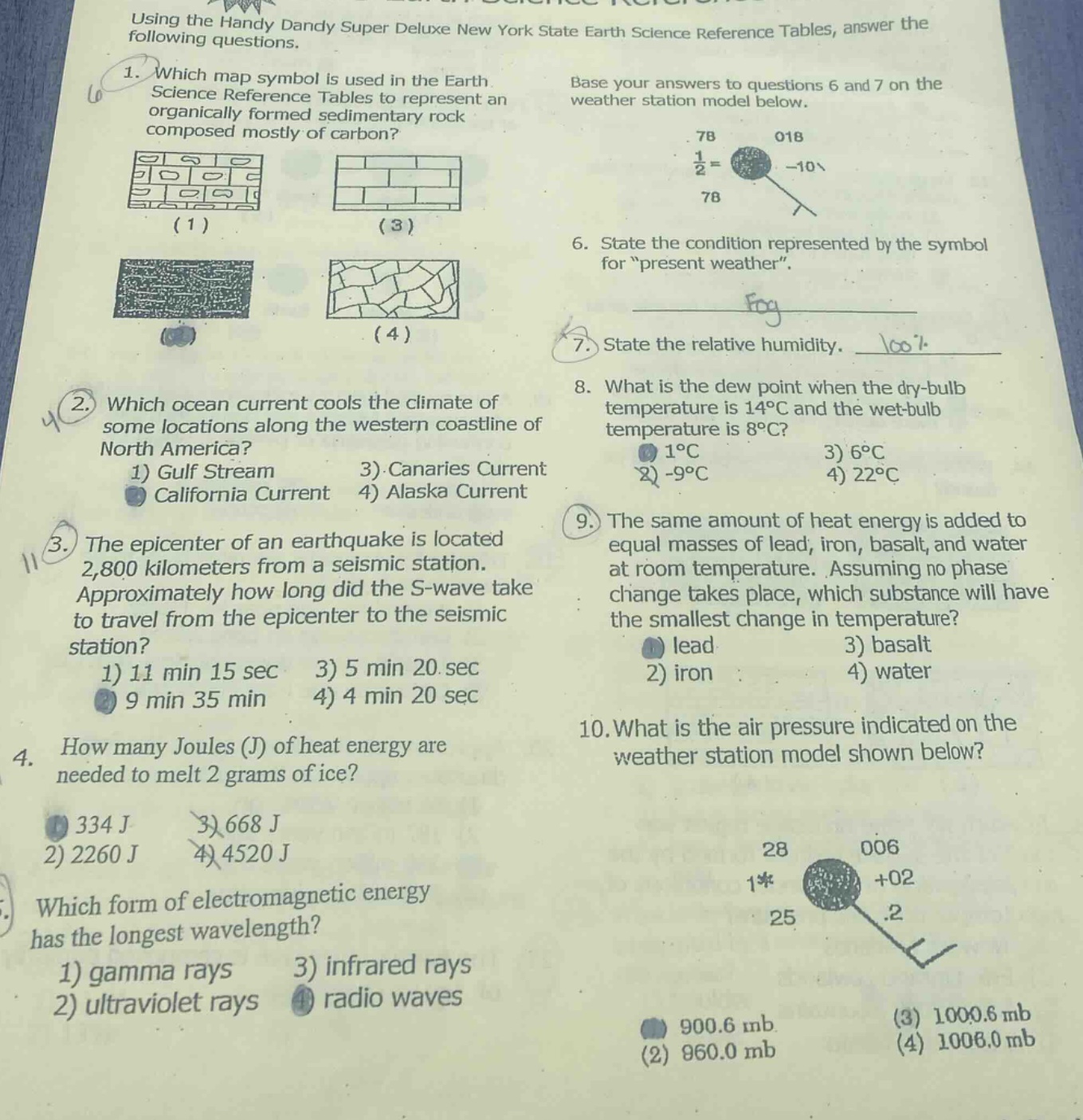
using the handy dandy super deluxe new york state earth science reference tables, answer the following questions.\n1. which map symbol is used in the earth science reference tables to represent an organically formed sedimentary rock composed mostly of carbon?\n2. which ocean current cools the climate of some locations along the western coastline of north america? 1) gulf stream 3) canaries current 2) california current 4) alaska current\n3. the epicenter of an earthquake is located 2,800 kilometers from a seismic station. approximately how long did the s - wave take to travel from the epicenter to the seismic station? 1) 11 min 15 sec 3) 5 min 20 sec 2) 9 min 35 min 4) 4 min 20 sec\n4. how many joules (j) of heat energy are needed to melt 2 grams of ice? 1) 334 j 3) 668 j 2) 2260 j 4) 4520 j\n5. which form of electromagnetic energy has the longest wavelength? 1) gamma rays 3) infrared rays 2) ultraviolet rays 4) radio waves\nbase your answers to questions 6 and 7 on the weather station model below.\n6. state the condition represented by the symbol for “present weather”.\n7. state the relative humidity.\n8. what is the dew point when the dry - bulb temperature is 14°c and the wet - bulb temperature is 8°c? 1) 1°c 3) 6°c 2) - 9°c 4) 22°c\n9. the same amount of heat energy is added to equal masses of lead, iron, basalt, and water at room temperature. assuming no phase change takes place, which substance will have the smallest change in temperature? 1) lead 3) basalt 2) iron 4) water\n10. what is the air pressure indicated on the weather station model shown below?
Answer
Explanation:
Step1: Identify the answer for question 1
Refer to Earth - Science Reference Tables for the symbol of an organically - formed sedimentary rock mostly of carbon. (No calculation, just identification).
Step2: Identify the answer for question 2
The California Current cools the western coastline of North America. It is a known fact about ocean currents.
Step3: Identify the answer for question 3
Use the S - wave travel time graph in Earth - Science Reference Tables. For a distance of 2800 km, the S - wave travel time is approximately 9 min 35 sec.
Step4: Identify the answer for question 4
The heat of fusion of ice is 334 J/g. For 2 g of ice, the heat energy needed is $Q = mL=2\times334 = 668$ J.
Step5: Identify the answer for question 5
Among the given electromagnetic waves, radio waves have the longest wavelength.
Step6: Identify the answer for question 6
The symbol in the weather - station model represents fog.
Step7: Identify the answer for question 7
The relative humidity is 100% as indicated by the weather - station model.
Step8: Identify the answer for question 8
Use the psychrometric chart. When dry - bulb temperature is 14°C and wet - bulb temperature is 8°C, the dew - point temperature is 1°C.
Step9: Identify the answer for question 9
Water has the highest specific heat capacity among lead, iron, basalt, and water. So, for the same heat energy added to equal masses, water will have the smallest change in temperature.
Step10: Identify the answer for question 10
In a weather - station model, the air pressure is indicated by the number to the right of the circle. Here, it is 1000.6 mb.
Answer:
- (No symbol shown in output as it depends on reference tables)
-
- California Current
-
- 9 min 35 sec
-
- 668 J
-
- radio waves
- Fog
- 100%
-
- 1°C
-
- water
-
- 1000.6 mb