7 how does a vacuum in a thermos help slow down heat transfer? a by preventing conduction through the…
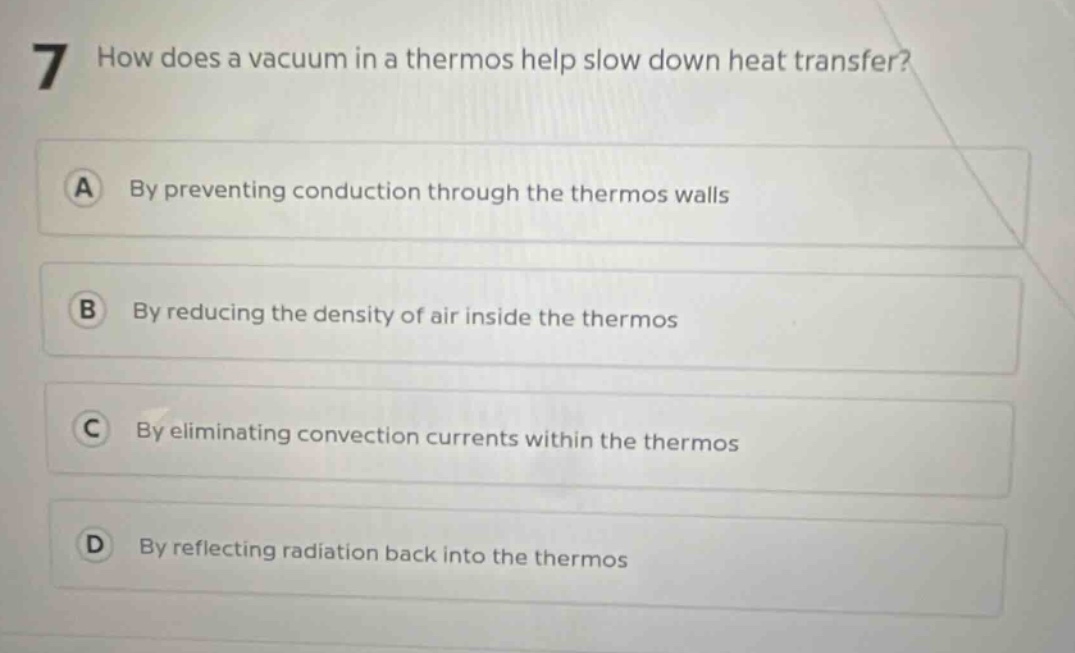
7 how does a vacuum in a thermos help slow down heat transfer? a by preventing conduction through the thermos walls b by reducing the density of air inside the thermos c by eliminating convection currents within the thermos d by reflecting radiation back into the thermos
Answer
Brief Explanations:
Heat transfer occurs via conduction, convection, and radiation. A vacuum in a thermos has no medium for conduction and convection. Conduction requires a material medium for heat - energy transfer through direct contact of particles, and convection involves the movement of a fluid medium (like air). Since a vacuum has no particles, conduction and convection are prevented. Option A only mentions conduction, while a vacuum prevents both conduction and convection. Option B is not the main reason. Option D is related to the silver - coated walls (not the vacuum) which reflect radiation. The key role of the vacuum is to eliminate convection currents as there is no fluid medium present.
Answer:
C. By eliminating convection currents within the thermos