the velocity of an object in meters per second varies directly with time in seconds since the object was…
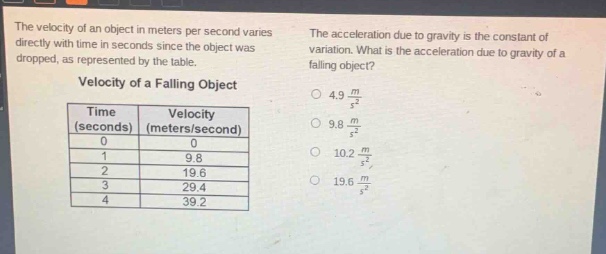
the velocity of an object in meters per second varies directly with time in seconds since the object was dropped, as represented by the table.\nvelocity of a falling object\n| time (seconds) | velocity (meters/second) |\n| ---- | ---- |\n| 0 | 0 |\n| 1 | 9.8 |\n| 2 | 19.6 |\n| 3 | 29.4 |\n| 4 | 39.2 |\nthe acceleration due to gravity is the constant of variation. what is the acceleration due to gravity of a falling object?\no 4.9 $\frac{m}{s^{2}}$\no 9.8 $\frac{m}{s^{2}}$\no 10.2 $\frac{m}{s^{2}}$\no 19.6 $\frac{m}{s^{2}}$
Answer
Answer:
B. $9.8\frac{m}{s^{2}}$
Explanation:
Step1: Recall acceleration - velocity relation
Acceleration $a=\frac{\Delta v}{\Delta t}$.
Step2: Select two - data points
Let's take $t_1 = 1s$, $v_1=9.8m/s$ and $t_2 = 2s$, $v_2 = 19.6m/s$.
Step3: Calculate acceleration
$a=\frac{v_2 - v_1}{t_2 - t_1}=\frac{19.6 - 9.8}{2 - 1}=\frac{9.8}{1}=9.8\frac{m}{s^{2}}$. We can also check with other pairs of data points. For example, taking $t_1 = 0s$, $v_1 = 0m/s$ and $t_2=1s$, $v_2 = 9.8m/s$. Then $a=\frac{9.8 - 0}{1 - 0}=9.8\frac{m}{s^{2}}$.