the velocity of an object in meters per second varies directly with time in seconds since the object was…
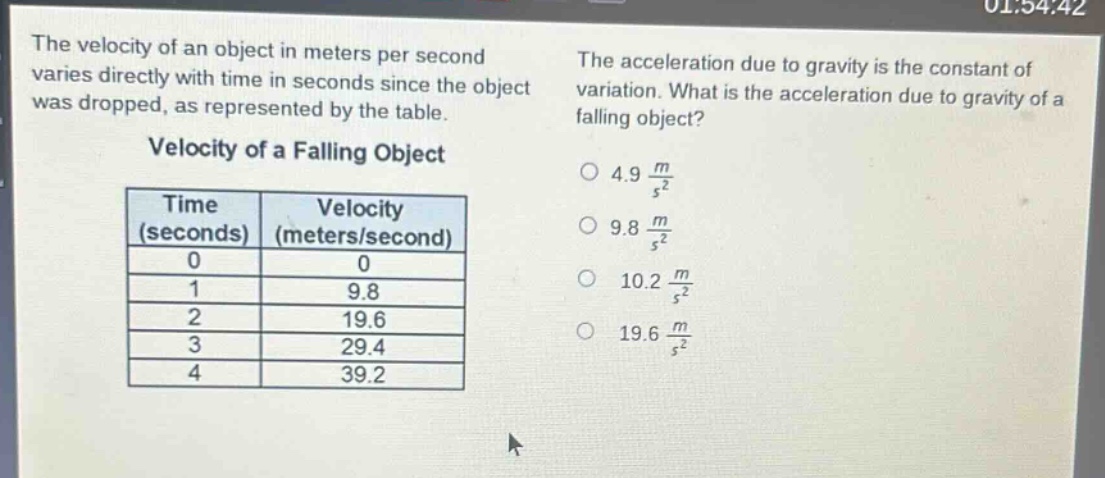
the velocity of an object in meters per second varies directly with time in seconds since the object was dropped, as represented by the table. velocity of a falling object\n| time (seconds) | velocity (meters/second) |\n| ---- | ---- |\n| 0 | 0 |\n| 1 | 9.8 |\n| 2 | 19.6 |\n| 3 | 29.4 |\n| 4 | 39.2 |\nthe acceleration due to gravity is the constant of variation. what is the acceleration due to gravity of a falling object?\n○ 4.9 $\frac{m}{s^{2}}$\n○ 9.8 $\frac{m}{s^{2}}$\n○ 10.2 $\frac{m}{s^{2}}$\n○ 19.6 $\frac{m}{s^{2}}$
Answer
Answer:
B. $9.8 , \frac{m}{s^2}$
Explanation:
Step1: Define acceleration.
Acceleration is the rate of change of velocity with respect to time. For constant acceleration, $a = \frac{\Delta v}{\Delta t}$.
Step2: Calculate acceleration using the first two data points.
Using the points $(t_1, v_1) = (0 , s, 0 , \frac{m}{s})$ and $(t_2, v_2) = (1 , s, 9.8 , \frac{m}{s})$: $$ a = \frac{v_2 - v_1}{t_2 - t_1} = \frac{9.8 , \frac{m}{s} - 0 , \frac{m}{s}}{1 , s - 0 , s} = \frac{9.8 , \frac{m}{s}}{1 , s} = 9.8 , \frac{m}{s^2} $$
Step3: Confirm acceleration using another pair of data points.
Using the points $(t_3, v_3) = (2 , s, 19.6 , \frac{m}{s})$ and $(t_4, v_4) = (3 , s, 29.4 , \frac{m}{s})$: $$ a = \frac{v_4 - v_3}{t_4 - t_3} = \frac{29.4 , \frac{m}{s} - 19.6 , \frac{m}{s}}{3 , s - 2 , s} = \frac{9.8 , \frac{m}{s}}{1 , s} = 9.8 , \frac{m}{s^2} $$
Step4: Identify the correct option.
The calculated acceleration due to gravity is $9.8 , \frac{m}{s^2}$, which corresponds to option B.