if velocity is positive, which would most likely yield a negative acceleration?\na final velocity that is…
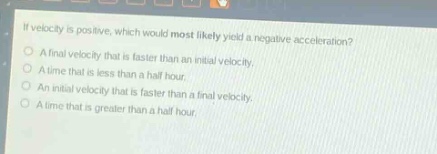
if velocity is positive, which would most likely yield a negative acceleration?\na final velocity that is faster than an initial velocity.\na time that is less than a half - hour.\nan initial velocity that is faster than a final velocity.\na time that is greater than a half hour.
Answer
Answer:
D. An initial velocity that is faster than a final velocity.
Explanation:
Step1: Recall acceleration formula
Acceleration $a=\frac{v_f - v_i}{t}$, where $v_f$ is final - velocity, $v_i$ is initial - velocity, and $t$ is time.
Step2: Analyze condition for negative acceleration
For $a$ to be negative, $v_f - v_i<0$. This implies $v_i>v_f$, i.e., the initial velocity is faster than the final velocity.
Step3: Evaluate other options
- Option A: If $v_f>v_i$, then $v_f - v_i>0$, so $a>0$ (positive acceleration).
- Option B and E: Time values alone do not determine the sign of acceleration. Acceleration depends on the change in velocity, not just the time elapsed.
- Option C: An initial velocity faster than the final velocity gives $v_f - v_i<0$, resulting in negative acceleration.