the volume of a fixed amount of gas is doubled, and the absolute temperature is doubled. according to the…
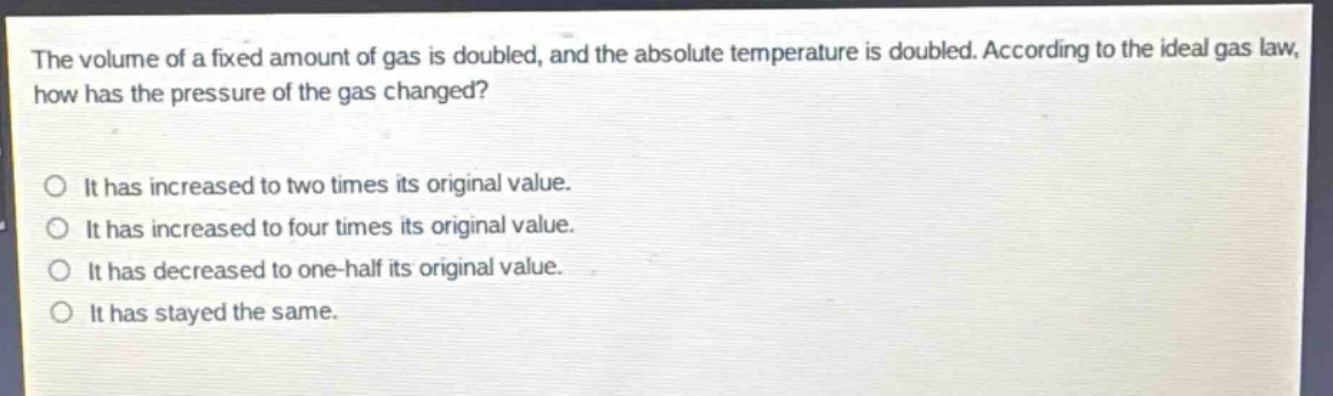
the volume of a fixed amount of gas is doubled, and the absolute temperature is doubled. according to the ideal gas law, how has the pressure of the gas changed?\n\nit has increased to two times its original value.\nit has increased to four times its original value.\nit has decreased to one - half its original value.\nit has stayed the same.
Answer
Explanation:
Step1: Write the ideal - gas law
The ideal - gas law is $PV = nRT$, where $P$ is pressure, $V$ is volume, $n$ is the amount of gas (constant here), $R$ is the ideal - gas constant, and $T$ is the absolute temperature. Let the initial state be $P_1V_1=nRT_1$, and the final state be $P_2V_2=nRT_2$.
Step2: Substitute the given changes
We know that $V_2 = 2V_1$ and $T_2 = 2T_1$. From $P_1V_1=nRT_1$ and $P_2V_2=nRT_2$, we can express $P_1=\frac{nRT_1}{V_1}$ and $P_2=\frac{nRT_2}{V_2}$. Substitute $V_2 = 2V_1$ and $T_2 = 2T_1$ into the formula for $P_2$: $P_2=\frac{nR(2T_1)}{2V_1}$.
Step3: Simplify the expression for $P_2$
$P_2=\frac{nR(2T_1)}{2V_1}=\frac{nRT_1}{V_1}$. Since $P_1=\frac{nRT_1}{V_1}$, we have $P_2 = P_1$.
Answer:
It has stayed the same.