the wage issue\nnike is one of the most famous names in sports shoes. it is based in beaverton, oregon…
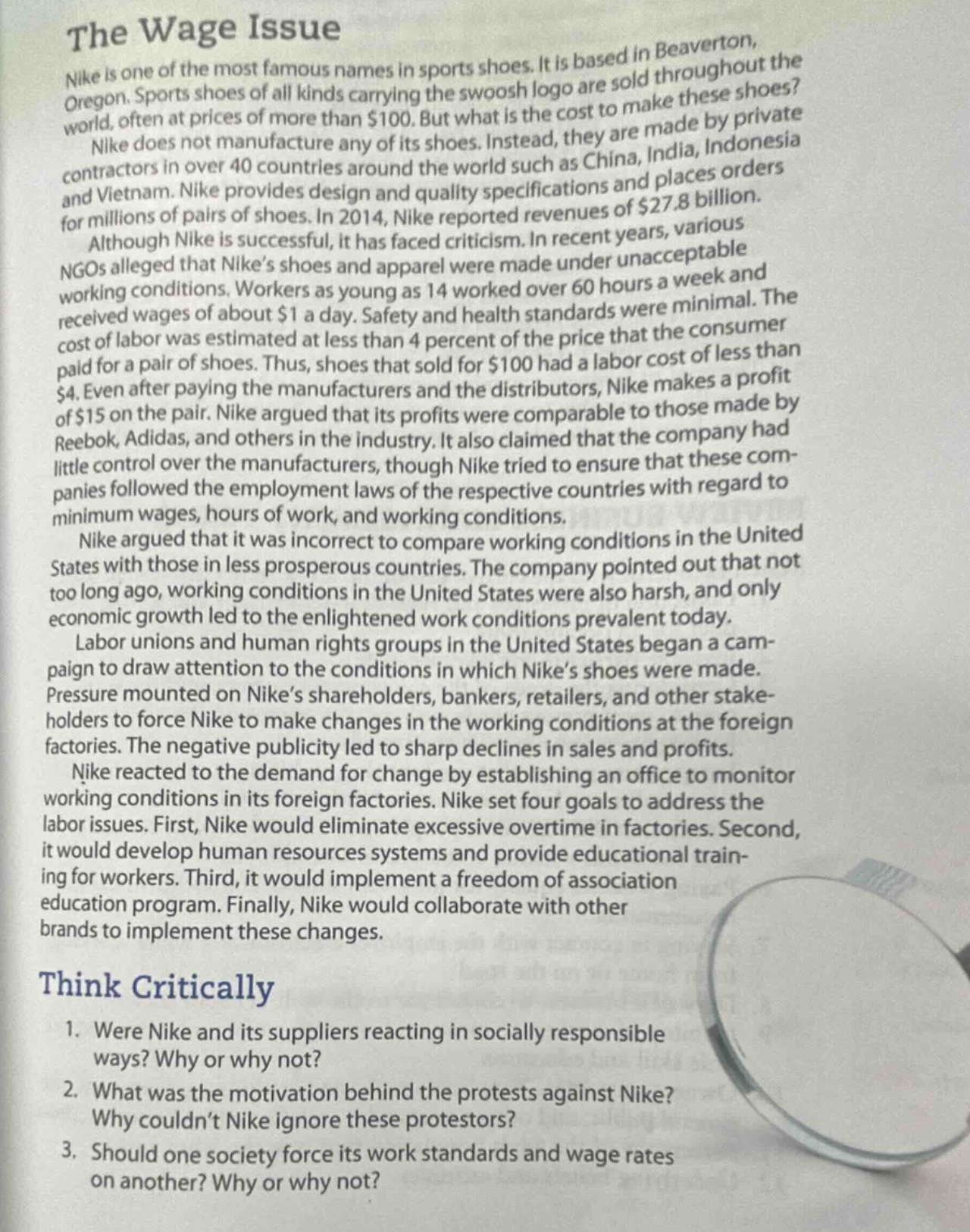
the wage issue\nnike is one of the most famous names in sports shoes. it is based in beaverton, oregon. sports shoes of all kinds carrying the swoosh logo are sold throughout the world, often at prices of more than $100. but what is the cost to make these shoes?\nnike does not manufacture any of its shoes. instead, they are made by private contractors in over 40 countries around the world such as china, india, indonesia and vietnam. nike provides design and quality specifications and places orders for millions of pairs of shoes. in 2014, nike reported revenues of $27.8 billion.\nalthough nike is successful, it has faced criticism. in recent years, various ngos alleged that nikes shoes and apparel were made under unacceptable working conditions. workers as young as 14 worked over 60 hours a week and received wages of about $1 a day. safety and health standards were minimal. the cost of labor was estimated at less than 4 percent of the price that the consumer paid for a pair of shoes. thus, shoes that sold for $100 had a labor cost of less than $4. even after paying the manufacturers and the distributors, nike makes a profit of $15 on the pair. nike argued that its profits were comparable to those made by reebok, adidas, and others in the industry. it also claimed that the company had little control over the manufacturers, though nike tried to ensure that these companies followed the employment laws of the respective countries with regard to minimum wages, hours of work, and working conditions.\nnike argued that it was incorrect to compare working conditions in the united states with those in less prosperous countries. the company pointed out that not too long ago, working conditions in the united states were also harsh, and only economic growth led to the enlightened work conditions prevalent today.\nlabor unions and human rights groups in the united states began a campaign to draw attention to the conditions in which nikes shoes were made. pressure mounted on nikes shareholders, bankers, retailers, and other stakeholders to force nike to make changes in the working conditions at the foreign factories. the negative publicity led to sharp declines in sales and profits.\nnike reacted to the demand for change by establishing an office to monitor working conditions in its foreign factories. nike set four goals to address the labor issues. first, nike would eliminate excessive overtime in factories. second, it would develop human resources systems and provide educational training for workers. third, it would implement a freedom of association education program. finally, nike would collaborate with other brands to implement these changes.\nthink critically\n1. were nike and its suppliers reacting in socially responsible ways? why or why not?\n2. what was the motivation behind the protests against nike? why couldnt nike ignore these protestors?\n3. should one society force its work standards and wage rates on another? why or why not?
Answer
Brief Explanations:
- The text suggests that initially, Nike and its suppliers were not acting in a fully socially responsible manner. While Nike argued it tried to ensure compliance with local laws, these laws often allowed for conditions (low wages, long hours, minimal safety standards) considered unacceptable by critics like NGOs, labor unions, and human rights groups. Nike's later reaction, driven by negative publicity and declining sales/profits, involved establishing monitoring, setting goals for improvement (reducing overtime, developing HR, providing training, ensuring freedom of association), indicating a shift towards more socially responsible practices under pressure.
- The motivation behind the protests was the alleged unacceptable working conditions in Nike's supplier factories, including very low wages (around $1/day), long working hours (over 60/week), minimal safety and health standards, and the employment of young workers. Nike could not ignore these protestors because the resulting negative publicity put pressure on stakeholders (shareholders, bankers, retailers) and led to sharp declines in sales and profits, directly impacting the company's financial health and brand reputation.
- This question involves complex ethical and economic considerations. Arguments for imposing standards often center on universal human rights and preventing exploitation. Arguments against emphasize national sovereignty, differing economic realities (like cost of living and productivity), and the risk that imposing standards could harm developing economies by reducing competitiveness and causing job losses. Nike itself argued against direct comparisons, noting that US standards evolved with economic growth. There is no single consensus; international bodies often advocate for core labor standards (safety, freedom of association, no forced/child labor) while acknowledging economic differences.
Answer:
- Initially, Nike and its suppliers' actions were arguably not fully socially responsible, prioritizing minimal legal compliance over addressing concerns about low wages and poor working conditions. However, facing significant pressure, Nike later reacted by implementing measures aimed at improving conditions, suggesting a move towards greater social responsibility.
- The protests were motivated by concerns over low wages, long hours, minimal safety standards, and the use of young workers in Nike's supplier factories, driven by labor unions and human rights groups. Nike couldn't ignore the protestors because the negative publicity significantly damaged its brand image and led to sharp declines in sales and profits.
- Whether one society should impose its work standards and wage rates on another is debatable. Proponents argue for universal rights and preventing exploitation, while opponents emphasize national sovereignty, economic differences, and potential negative impacts on employment in developing countries. A balanced approach might involve promoting core international labor standards while respecting differing economic contexts.