wave observations\nw its motion is perpendicular to wave motion.\nx its particles move up and down.\ny its…
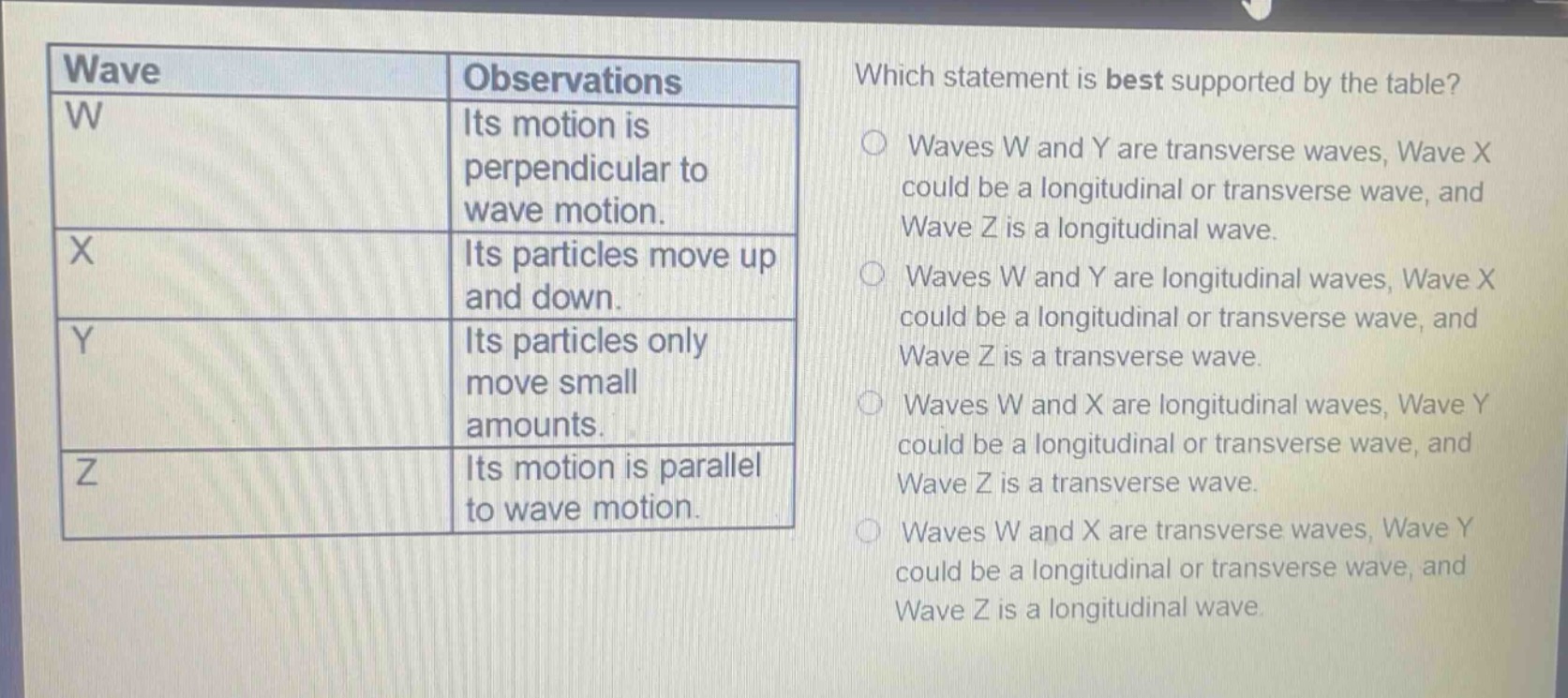
wave observations\nw its motion is perpendicular to wave motion.\nx its particles move up and down.\ny its particles only move small amounts.\nz its motion is parallel to wave motion.\nwhich statement is best supported by the table?\nwaves w and y are transverse waves, wave x could be a longitudinal or transverse wave, and wave z is a longitudinal wave.\nwaves w and y are longitudinal waves, wave x could be a longitudinal or transverse wave, and wave z is a transverse wave.\nwaves w and x are longitudinal waves, wave y could be a longitudinal or transverse wave, and wave z is a transverse wave.\nwaves w and x are transverse waves, wave y could be a longitudinal or transverse wave, and wave z is a longitudinal wave.
Answer
Brief Explanations:
- Transverse waves have particle motion perpendicular to wave motion. Wave W has motion perpendicular to wave motion, so it is a transverse wave.
- In transverse waves, particles can move up and down. Wave X has particles moving up and down, so it could be a transverse wave.
- Longitudinal waves have particle motion parallel to wave motion. Wave Z has motion parallel to wave motion, so it is a longitudinal wave.
- The statement about particles moving small amounts (Wave Y) is not specific enough to determine if it's longitudinal or transverse.
Answer:
Waves W and X are transverse waves, Wave Y could be a longitudinal or transverse wave, and Wave Z is a longitudinal wave.