wave|observations\nw|its motion is perpendicular to wave motion.\nx|its particles move up and down.\ny|its…
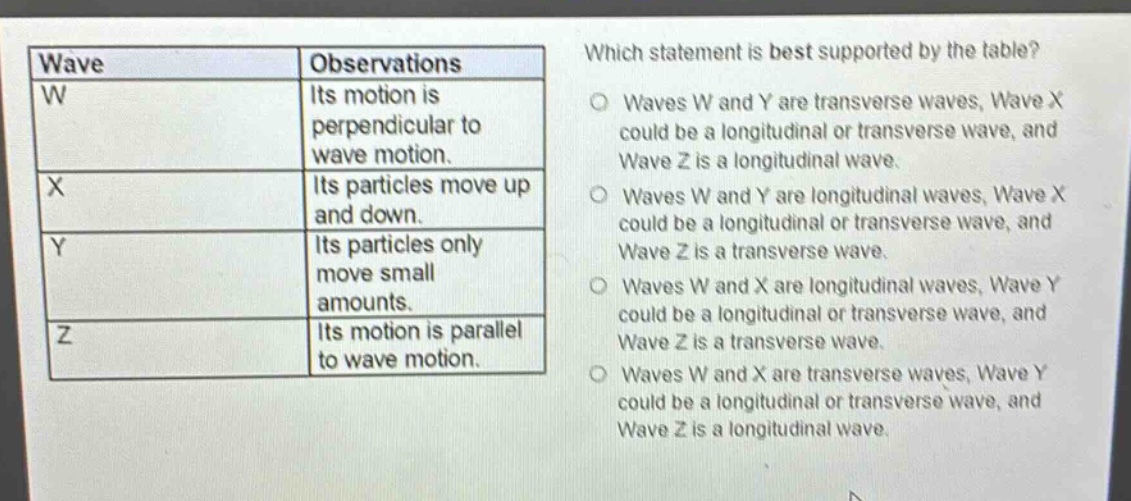
wave|observations\nw|its motion is perpendicular to wave motion.\nx|its particles move up and down.\ny|its particles only move small amounts.\nz|its motion is parallel to wave motion.\nwhich statement is best supported by the table?\nwaves w and y are transverse waves, wave x could be a longitudinal or transverse wave, and wave z is a longitudinal wave.\nwaves w and y are longitudinal waves, wave x could be a longitudinal or transverse wave, and wave z is a transverse wave.\nwaves w and x are longitudinal waves, wave y could be a longitudinal or transverse wave, and wave z is a transverse wave.\nwaves w and x are transverse waves, wave y could be a longitudinal or transverse wave, and wave z is a longitudinal wave.
Answer
Answer:
Waves W and X are transverse waves, Wave Y could be a longitudinal or transverse wave, and Wave Z is a longitudinal wave.
Explanation:
Step1: Recall wave - type characteristics
Transverse waves have particle motion perpendicular to wave motion. Longitudinal waves have particle motion parallel to wave motion.
Step2: Analyze Wave W
Wave W has motion perpendicular to wave motion, so it is a transverse wave.
Step3: Analyze Wave X
Particles of Wave X move up and down, which implies motion perpendicular to wave motion (assuming wave is moving horizontally), so it is a transverse wave.
Step4: Analyze Wave Y
The fact that particles only move small amounts does not clearly distinguish between longitudinal or transverse, so it could be either.
Step5: Analyze Wave Z
Wave Z has motion parallel to wave motion, so it is a longitudinal wave.