we now know that supermassive black holes are common in the cores of galaxies. for some galaxies, a…
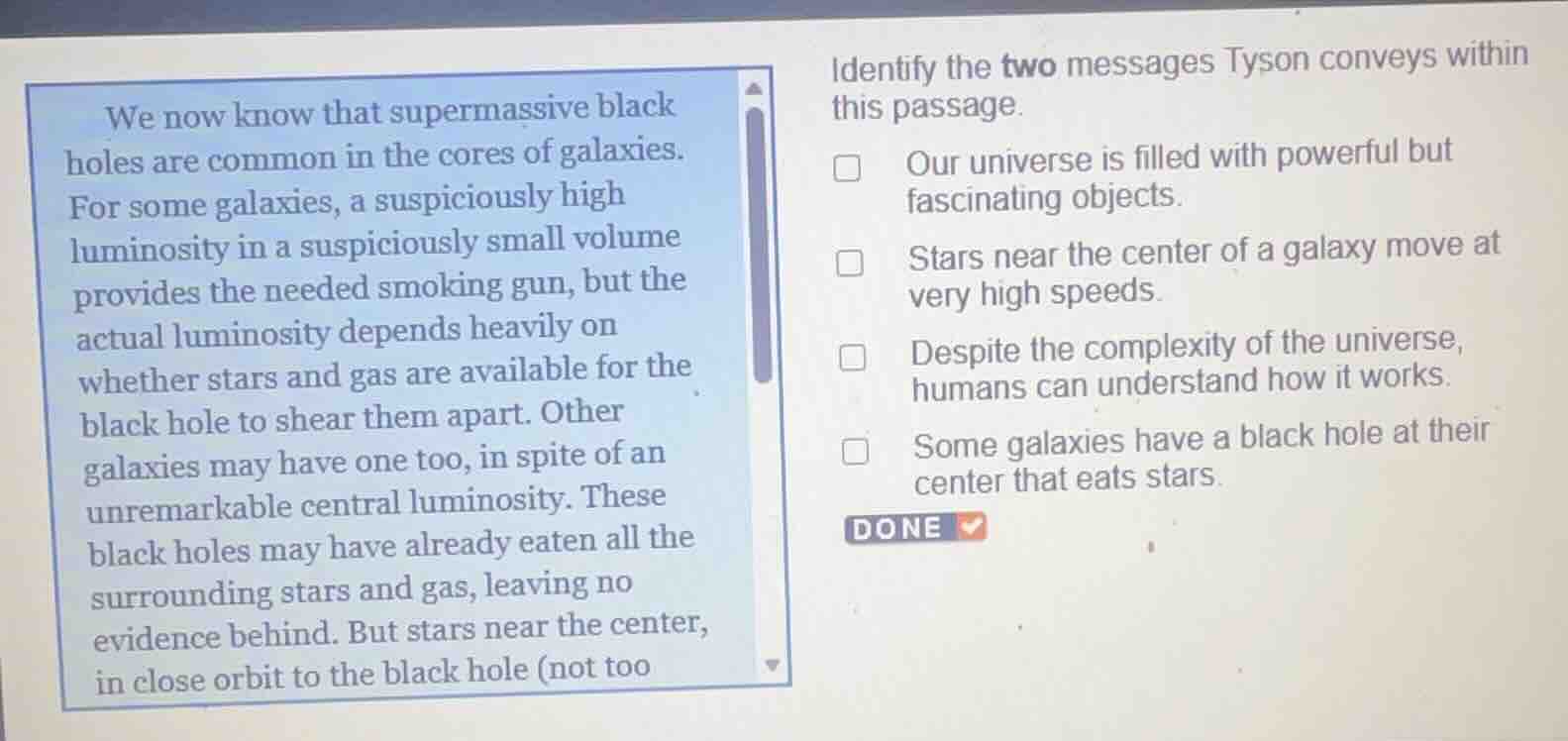
we now know that supermassive black holes are common in the cores of galaxies. for some galaxies, a suspiciously high luminosity in a suspiciously small volume provides the needed smoking gun, but the actual luminosity depends heavily on whether stars and gas are available for the black hole to shear them apart. other galaxies may have one too, in spite of an unremarkable central luminosity. these black holes may have already eaten all the surrounding stars and gas, leaving no evidence behind. but stars near the center, in close orbit to the black hole (not too\n\nidentify the two messages tyson conveys within this passage.\n- our universe is filled with powerful but fascinating objects.\n- stars near the center of a galaxy move at very high speeds.\n- despite the complexity of the universe, humans can understand how it works.\n- some galaxies have a black hole at their center that eats stars.
Answer
Brief Explanations:
The passage discusses the prevalence of supermassive black holes in galactic cores and the scientific methods used to detect them. The first message is identified through the opening statement "We now know," which implies that despite the complexity of these celestial phenomena, human scientific inquiry has successfully gained understanding of their existence and behavior. The second message is found in the description of how black holes "shear apart" stars and gas to produce luminosity, or may have "already eaten all the surrounding stars," directly supporting the idea that some galaxies contain black holes that consume stellar matter. The other options regarding high speeds or general fascination are not the primary focus of this specific excerpt.
Answer:
- Despite the complexity of the universe, humans can understand how it works.
- Some galaxies have a black hole at their center that eats stars.