if we were to pass neon gas through a prism, would the spectrum we see be like that of hydrogen? a not…
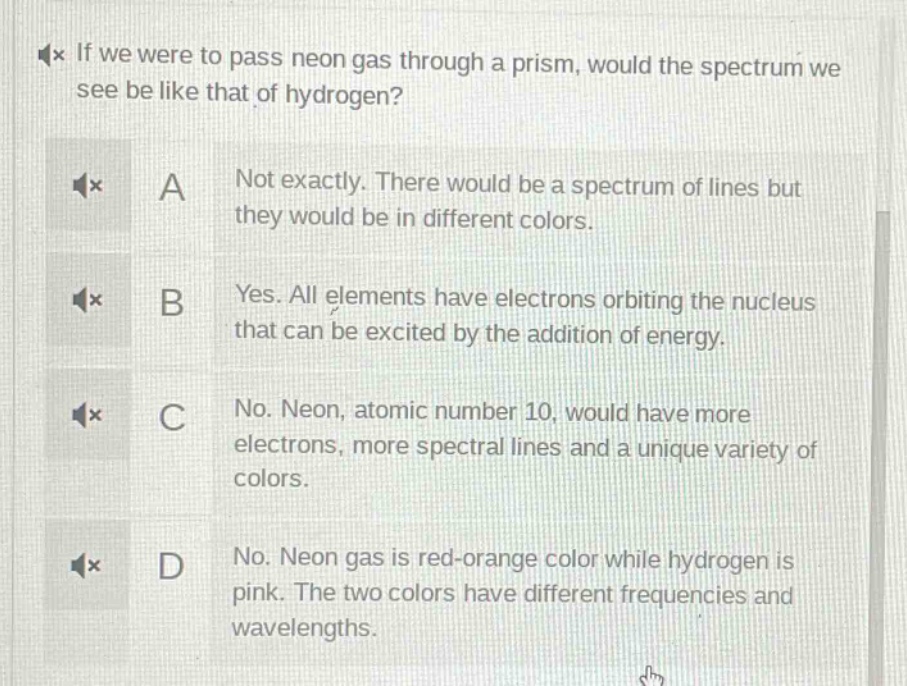
if we were to pass neon gas through a prism, would the spectrum we see be like that of hydrogen? a not exactly. there would be a spectrum of lines but they would be in different colors. b yes. all elements have electrons orbiting the nucleus that can be excited by the addition of energy. c no. neon, atomic number 10, would have more electrons, more spectral lines and a unique variety of colors. d no. neon gas is red - orange color while hydrogen is pink. the two colors have different frequencies and wavelengths.
Answer
Brief Explanations:
Each element has a unique set of electron configurations. When electrons are excited and then return to lower energy states, they emit light at specific wavelengths (spectral lines). Neon (atomic number 10) has more electrons than hydrogen (atomic number 1). More electrons mean more possible energy level transitions, resulting in more spectral lines. Also, the specific energy differences (which determine the color - related to wavelength and frequency) are unique for each element.
- Option A: Just saying different colors is an oversimplification. The number of spectral lines also differs.
- Option B: While it's true that all elements have electrons that can be excited, this does not explain why the spectra are different.
- Option C: Correctly points out that neon has more electrons (due to higher atomic number), more spectral lines, and unique colors (based on unique energy level transitions).
- Option D: The color description (red - orange for neon and pink for hydrogen) is not the fundamental reason. The key is the number of electrons and the resulting spectral lines from energy level transitions.
Answer:
C. No. Neon, atomic number 10, would have more electrons, more spectral lines and a unique variety of colors.